


Who Are Canada’s Key Patent Holders?
A Comparative Analysis With the U.S. Holders
French • April 24, 2026
Key findings
- Canada exhibits higher patent concentration than the U.S. in several technology areas. In microstructural and nanotechnology, Canada’s top 10 holders account for 39.5 per cent of patents versus 18.9 per cent in the U.S.; in information technology (IT) methods for management, the figures are 36.0 per cent for Canada and 17.4 per cent for the U.S.; in biotechnology, Canada’s top 10 holders account for 27.5 per cent of patents versus 12.4 per cent in the United States.
- On the other hand, Canada exhibits lower patent concentration than the U.S. in several technology areas. In computer technology, the figures are 13.4 per cent for Canada and 29.8 per cent for the U.S.; in textile and paper machines, Canada’s top 10 holders account for 15.1 per cent of patents versus 27.3 per cent in the U.S.; in optics, Canada’s top 10 holders account for 17.5 per cent of patents versus 25.6 per cent in the United States.
- U.S. patent portfolios are more commercialization-oriented, with private companies dominating top patent ownership. In nearly every technology class, the U.S. top 10 patent holders are exclusively private companies, while Canada’s lists frequently include universities and government entities. For instance, in optics, Institut National d’optique is Canada’s top patent holder.
- Government agencies and universities are frequently among Canada’s top patent holders, particularly in fields like biotechnology, pharmaceuticals, and nanotechnology. For example, only one of the top 10 patent holders in biotechnology in Canada is a company, while there are six companies in the top 10 for the United States. This public sector presence reflects strong research capacity in Canada but also highlights the need for better commercialization linkages to translate scientific advances into innovations.
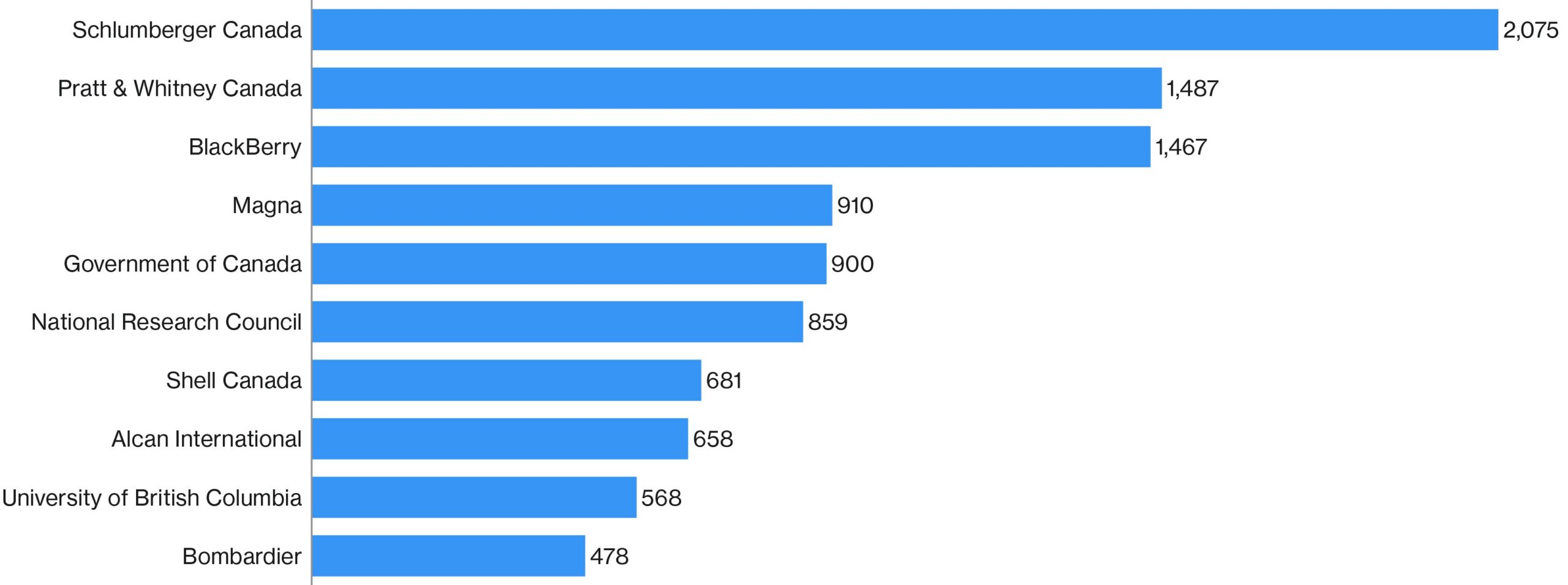
- Canada’s top patent holders span industry, university, and government, reflecting a diverse innovation ecosystem. Leading organizations like Schlumberger Canada (2,077 patent families), Pratt & Whitney Canada (1,487), and BlackBerry (1,467) are joined by public institutions and universities, highlighting both strong research capacity and the need to strengthen commercialization pathways.
- Across 35 technology classes, the share of total patents held by the top 10 organizations is broadly similar between Canada and the United States. On average, Canada’s top patent holders capture only 2.19 percentage points more of all patents than their U.S. counterparts—a difference that is not statistically significant.
Patent ownership and commercialization potential

When patents are concentrated within a small number of firms, it typically signals the presence of organizations with stronger commercialization capabilities, which research shows is a key driver of invention value.1 Conversely, a more diffused ownership structure may indicate barriers to scaling and market deployment, especially when patents are held by entities less equipped to commercialize inventions.2 Private companies may have the resources, market access, and incentives to bring inventions to market, while universities and government agencies tend to focus on research and public-interest outcomes, making them less commercially oriented unless strong industry partnerships are in place.
The data briefings listed below,3 which spotlight the top patent holders in each technology class, provide a more granular view of who is driving innovation in Canada and how these actors compare with their U.S. counterparts.
They complement the findings of our previous research, Intellectual Property in Canada: Technology Specialization and Competitive Advantage, which mapped Canada’s inventive strengths and weaknesses but did not focus on the actors behind them. We highlight where Canada’s innovation leadership is anchored in industry or dispersed across public and academic institutions, an essential distinction for understanding commercialization pathways.
• Canada’s Key Patent Holders in Electrical Engineering (forthcoming)
• Canada’s Key Patent Holders in Chemistry (forthcoming)
• Canada’s Key Patent Holders in Mechanical Engineering (forthcoming)
• Canada’s Key Patent Holders in Instruments and Other Technologies (forthcoming)

Each briefing identifies Canada’s top 10 patent holders across relevant technology classes and compares their patent ownership concentration with that of the United States. Drawing on the analysis of 110,231 patent families for Canada and 3,641,893 for the U.S., we examine both the share of total patents held by leading organizations and the types of entities involved—private companies, universities, government agencies, and individuals.4 Patent families are compared against the overall portfolio size of each country allowing more direct comparisons between the two countries. We also identify the country source of the innovation activity being patented. Our analysis has two central insights:
• the degree of ownership concentration
• the commercialization potential of Canada’s innovation system.
For policy-makers, this data helps identify key organizations for targeted support, whether through IP policy or investment incentives. For innovators, it clarifies the competitive landscape and reveals potential partners for collaboration or licensing. From a national innovation system perspective, patents held by private companies are especially valuable, as they are more likely to be commercialized and scaled. Ultimately, our evidence-based approach informs innovation policy aimed at strengthening Canada’s global competitiveness.
Comparing concentration, not volume
While it is obvious that Canada and the U.S. differ considerably in economic size and overall patenting activity, this analysis does not aim to compare the absolute number of patents held by organizations in each country. Instead, it focuses on the share of total patents held by the top 10 patent holders and the composition of those organizations. These indicators are normalized and unaffected by the size differences between the two economies, allowing for meaningful insights into ownership concentration and commercialization potential.
Market concentration and competition
While high market concentration can raise valid concerns about reduced competitiveness or monopolistic behaviour—particularly in consumer-facing sectors such as grocery retail or airlines—this dynamic differs in knowledge-intensive, innovation-driven sectors. In these sectors, competition is global, and technological leadership is often determined by the ability to scale, attract talent, and invest in research and development.
Canada’s top patent holders

Among Canada’s leading patent holders, several organizations stand out for the size of their portfolios. Schlumberger Canada leads with 2,075 unique patent families, followed by Pratt & Whitney Canada with 1,487, and BlackBerry with 1,467. (See Chart 1.) These figures reflect strong corporate engagement in innovation, particularly in energy, aerospace, and digital technologies.
Notably, public institutions such as the National Research Council of Canada (859 families) and major universities like the University of British Columbia (568) rank among the top holders, underscoring the important role of government and academia in Canada’s innovation system.
This mix of private and public entities highlights both the diversity of Canada’s inventive activity and the importance of bridging research with commercialization.
Chart 1
Top patent holders in Canada by number of patent families
(number of active patent families with enforceable intellectual property rights as of 2024)
Source: Signal49 Research.
Broad patent ownership versus commercialization
Our analysis reveals that patents are spread across a wider range of entities beyond companies in Canada, including universities and government agencies. While this diversity signals broad participation in research, it also points to challenges in scaling and commercialization, particularly if key patents are held by non-business entities such as governments and universities with limited market deployment capacity.
For more information, please download the Methodology.

Canada has an innovation problem. We have a highly educated workforce and strong research capability, but consistently lack commercial success and innovation-based economic growth. This problem is known as Canada’s innovation paradox, and it’s the problem the Canadian Centre for the Innovation Economy is here to address.
The Canadian Centre for the Innovation Economy (CCIE) will drive national innovation performance by using data-driven insights to unpack the significant pain points to improve innovation in Canada.
CCIE aims to be the destination of choice for trusted, timely insights and policy recommendations on the innovation economy.
Our research reveals the ways Canada can enhance its productivity and global competitiveness through innovation. We focus on how we can accelerate technology adoption and the scaling up of Canadian businesses. Additionally, we analyze the implications of technological advancements on the future of work.
Our Research Centre is funded by multiple members—united in their mission for progress—who help support and inform the Centre’s research agenda. We appreciate the support from our Funding Members. Their passion and understanding of the urgent need for progress helps propel us forward and allows us to conduct research that matters.
To become a member of the CCIE, visit us.
Funding members









- Ashish Arora and others, “Invention value, inventive capability and the large firm advantage,” Research Policy 52, no. 1 (2023), https://doi.org/10.1016/j.respol.2022.104650; and S. S. Athreye and others, “Small firms and patenting revisited,” Small Business Economics 57 (2021): 513–30, https://doi.org/10.1007/s11187-020-00323-1.
- Statistics Canada, “Size counts: Outcomes of intellectual property (IP) commercialization,” Government of Canada, 2024, https://www150.statcan.gc.ca/n1/pub/88-003-x/2007001/4064508-eng.htm; and David H. Hsu and others, “Benchmarking U.S. university patent value and commercialization efforts: A new approach,” Research Policy 50, no. 1 (January 2021), https://doi.org/10.1016/j.respol.2020.104076.
- These four data briefings correspond to the major technology areas as defined by the World Intellectual Property Organization (WIPO): Ulrich Schmoch, Concept of a Technology Classification for Country Comparisons, WIPO, 2008, https://www.wipo.int/edocs/mdocs/classifications/en/ipc_ce_41/ipc_ce_41_5-annex1.pdf.
- For ease of reference and simplicity, we use “patents” to refer to “patent families.” A patent family is a collection of patents that are considered to cover a single invention. We focus on patent families instead of patents because individual patents inflate patent counts for companies as they file patents for strategic/litigation reasons other than simply disclosing a novel product or process. European Patent Office, “DOCDB simple patent family,” EPO, n.d., https://www.epo.org/en/searching-for-patents/helpful-resources/first-time-here/patent-families/docdb.