



Transitioning to a low-carbon economy will bring changes to the Canadian workforce.
Signal49 Research, on behalf of the Future Skills Centre, is researching how measures to reduce greenhouse gas emissions will affect demand for skilled tradespeople in construction and how education and training programs can prepare to meet this demand.

In this project, we will:
- identify multiple future emissions scenarios for Canada’s economy;
- forecast the demand for skilled trades in construction across these scenarios;
- develop education and training recommendations to ensure a steady supply of skilled tradespeople for the future.
Navigating uncertainty
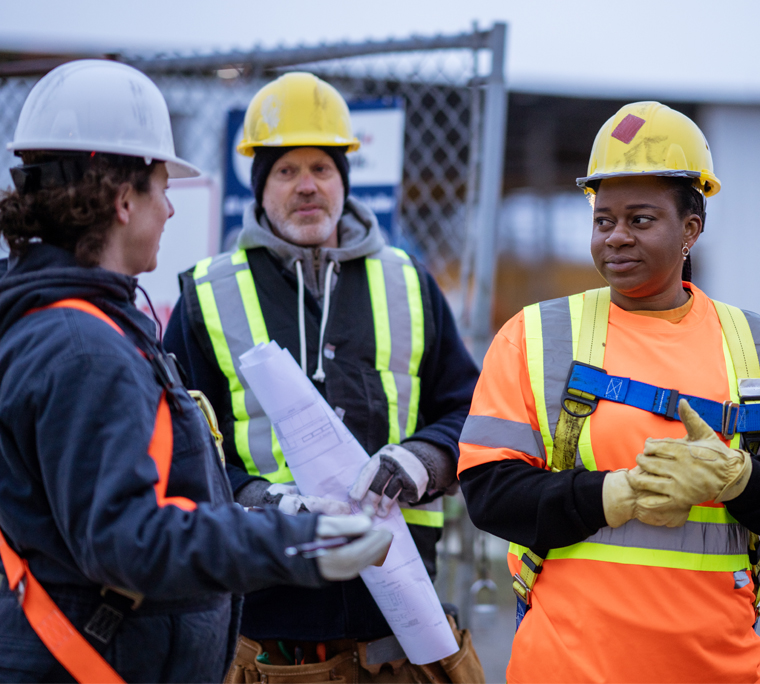
To anticipate the workforce needs of tomorrow, we need flexible strategies that account for the evolving demands of transitioning to a low-carbon economy. However, the exact nature of this transition—and its impact on key industries like construction—remains uncertain.
Our research will assess future demand for skilled trades in construction under multiple scenarios, each with a different level of emissions abatement and unique implications for workforce requirements and skill demands. This approach will provide higher education and skills training providers with valuable insights into the changing needs of the construction sector as it navigates evolving environmental and regulatory landscapes. We will also be able to assess what needs are common across all scenarios.
Why skilled trades matter
Skilled tradespeople will be a critical part of building the infrastructure, homes, transportation networks, and energy systems that will be required to reduce Canada’s emissions.
Yet the construction sector is already grappling with a growing labour shortage, as retirements are outpacing the entry of younger workers. This is creating a widening skills gap that could delay critical infrastructure projects in Canada, a problem that will only worsen as the workforce continues to age and the demand for sustainable infrastructure continues to rise.
Strategically aligning education and training programs with projected industry needs is key to closing this gap and moving Canada into the future.
Charting a path forward

We need actionable strategies to align education and training programs with changing needs and ensure a steady pipeline of skilled tradespeople.
To achieve this, we will speak with stakeholders across higher education and construction on topics that affect both sectors, such as the following:
- Building cross-sector partnerships.
- Enhancing training programs to align with evolving industry needs.
- Removing barriers to skills training.
- Addressing recruitment and hiring challenges.
Building a future-ready construction workforce
To support higher education and skills training providers in building the construction workforce of tomorrow, this project will focus on two approaches:
Forecasting skilled trades demand
We will employ advanced forecasting methods to analyze the demand for skilled trades across distinct future emission scenarios, offering a comprehensive and dynamic understanding of future workforce needs.
Engaging stakeholders
Through 50 interviews with post-secondary institution leaders and managers, HR professionals, and training specialists from the construction industry, we will identify innovative, practical solutions to address workforce shortages and align training programs with evolving demands.
Get involved
If you’re interested in learning more about this study or participating in an interview, please contact Adam Vanzella Yang, Senior Research Associate, Education & Skills ([email protected]).