

Human Resources Toolkit
Approaches for Skills Inclusion in Inuit Nunangat
June 20, 2023
What is this toolkit, and how can it help me?
This toolkit will help employers with recruitment and retention in Inuit Nunangat through meaningful inclusion practices, policies that accommodate Traditional practices and community responsibilities, and clear career paths. It will help you meet your commitments to:
- equity, diversity, inclusion, and belonging
- corporate social responsibility
- environmental, social, and corporate governance principles
- Inuit Impact and Benefit Agreements (IIBAs)
It has four sections themed around an immediate challenge you might have as a:

Senior leader focused on an organizational strategy for Inuit inclusion

Human resources leader setting the vision for inclusive policies and psychologically safe workplaces in Inuit Nunangat

Manager looking for tools to promote open discussion within your team and retain Inuit staff

Hiring manager or recruiter wanting to recruit Inuit employees

Human resources team member or occupational health and safety representative supporting team well-being
Our tools will use the icons above to help you identify the most relevant tools for your role.
Recognizing the diversity of Indigenous communities
Indigenous Peoples across the territory currently known as Canada are diverse. First Nation, Métis, and Inuit are constitutionally recognized groups in Canada. But within these groups are distinct cultures, languages, regions, and economic circumstances. We recognize these distinctions, and the reader should understand that the recommendations of this toolkit do not necessarily reflect the views of all Indigenous Peoples in Canada.

Download tools



Workplace Learning and Career Navigation
Incorporating Inuit Perspectives and Values in Workplace Learning
Inuit Perspectives on Workplace Learning
What Inuit Societal Values informed this toolkit?
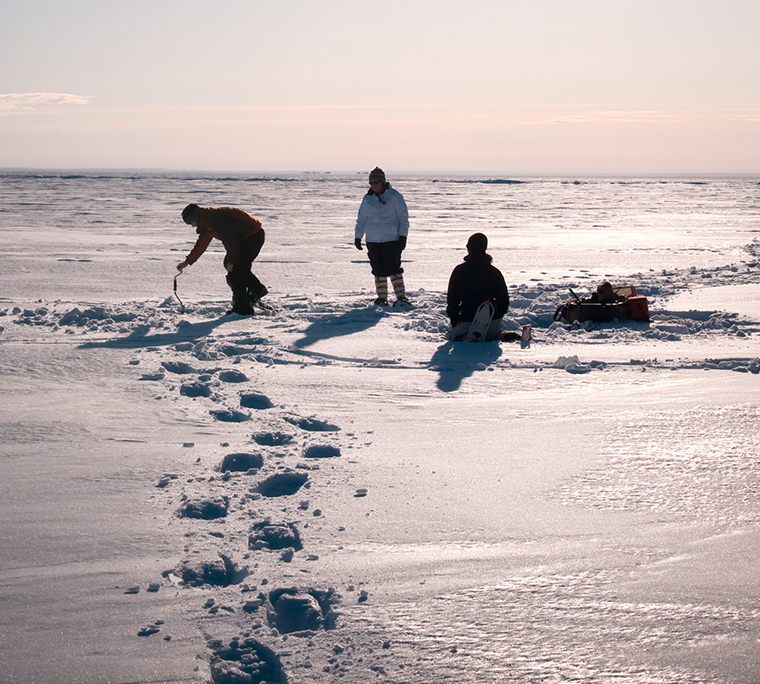
Inuit Societal Values guide all aspects of life. The following eight principles for the workplace have been adapted from the Government of Nunavut’s Public Service Annual Report 2020–21 and inform this toolkit. They guide respectful relationships, management practices, lifelong learning, and governance.
inuuqatigiitsiarniq
“Respecting others, relationships and caring for people.”
Workplaces demonstrate inclusive recruitment processes and develop equitable policies in the workplace.
tunnganarniq
“Fostering good spirits by being open, welcoming and inclusive.”
Workplaces are friendly, welcoming, and accepting. When possible, employers remove barriers that affect an employee’s ability to work productively.
pijitsirniq
“Serving and providing for family and/or community.”
Supportive workplaces have peer assistance, empowering performance conversations, and inclusive policies. They prioritize employee mental health and well-being.
aajiiqatigiinniq
“Decision making through discussion and consensus.”
Workplaces demonstrate inclusive recruitment processes and develop equitable policies in the workplace.
pilimmaksarniq/pijariuqsarniq
“Development of skills through observation, mentoring, practice and effort.”
Workplaces provide training, mentoring, and professional development.
piliriqatigiinniq/ikajuqtigiinniq
“Working together for a common cause.”
Workplaces promote collaboration and mutual understanding in programs and services.
qanuqtuurniq
“Being innovative and resourceful.”
Psychologically safe workplaces have supportive managers that encourage an environment of trust and innovation.
avatittinnik kamatsiarniq
“Respect and care for the land, animals, and the environment.”
Workplaces promote collaboration and mutual understanding in programs and services.
How do I use this toolkit?
This toolkit helps employers integrate Inuit values into their policies and procedures. But where should you start? We encourage using a process called Two-Eyed Seeing. This concept is based on Mi’kmaq principles of Etuaptmumk. Central to Two-Eyed Seeing is a respect for diversity of thought and ways of knowing. Two-Eyed Seeing means learning how to see the world from multiple perspectives and developing solutions with the strengths of different worldviews. A similar concept in Inuit Nunangat, isumaqatigingniq, or “thinking together,” has been used in education to bring together Inuit and scientific research.
When you use this resource, practise Two-Eyed Seeing by:
- learning about Inuit Societal Values and their importance for guiding work and life;
- identifying ways to apply similar principles in your work and life experiences;
- finding similarities between these principles and your organization’s mission and vision;
- identifying ways these principles can guide revisions to existing policies and practices, or help you develop new ones.
Two-Eyed Seeing approaches can help you decolonize the workplace and better meet the needs of Inuit employees. Use these approaches to inform and guide organizational, departmental, and team objectives.
Why is this toolkit important?

The opportunity ahead
Increasing Indigenous representation in the workplace is an important path to reconciliation in Canada. Workplaces that promote diversity, equity, and inclusion have stronger financial performance and increased retention, productivity, and regular attendance.
High rates of retirement and labour shortages are expected over the next five years, creating both challenges and opportunities to imagining workforces that better reflect the diversity of the Canadian population.
Workforces are already under-representative of Indigenous Peoples, most notably in senior positions. But Inuit are the fastest-growing population in Canada, and Inuit youth are approaching working age and entering the labour force. Enhancing processes and procedures can help your organization recruit and retain a diverse workforce that includes Inuit at all levels.

Addressing this opportunity
Given this opportunity to increase Inuit representation in the workforce in Inuit Nunangat, here’s why you should use this toolkit to accomplish that goal.
It makes good business sense. Diverse, equitable, and inclusive workplaces have stronger financial performance and profitability. An increased sense of inclusion or belonging makes employees less likely to leave and more productive, and employees take fewer sick days.
It includes actions your organization can take toward reconciliation. The Truth and Reconciliation Commission has calls to action for the corporate sector, which include improving employment relations with Indigenous peoples, and the United Nations Declaration on the Rights of Indigenous Peoples affirms Indigenous Peoples’ rights to equitable access to employment.
Our toolkit asks employers in Inuit Nunangat to reflect on how their human resources policies impact Inuit employees.
It includes practical steps for non-Inuit employers to honour Inuit values in the workplace. Indigenous Peoples face stereotypes and racism in the workplace. They report that an employer’s “lack of awareness of Indigenous culture” is a major reason they leave. This toolkit has prompts and actionable steps to help you integrate and benefit from Inuit values in the workplace.
It can increase Inuit recruitment and retention. Commercial operators, governments, and regional groups sign Inuit Impact and Benefit Agreements (IIBAs) that accommodate Inuit land claims and promote community interests, including hiring local Inuit labour. IIBAs outline Inuit training, procurement, and employment to increase labour market participation. This toolkit helps employers support the implementation of these commitments.
Recruitment and retention for employers in Inuit Nunangat
Recruitment
This toolkit will help employers address recruitment challenges, including cultural biases and job descriptions that require more education than is truly necessary. Employers have an opportunity to consider new ways of designing jobs, developing interview guides, and designing supportive policies—all of which are addressed in this toolkit.
Inuit identity and food security are centred on land-based activities and helping others in their communities. Employers need to consider how Inuit experiences in wage- and land-based economies are assessed and valued during recruitment.
Retention
This toolkit will help employers address retention challenges in Inuit Nunangat through inclusive practices, policies that accommodate community responsibilities, and supportive manager–employee conversations. Workplace wellness culture has been found to require safety and positive peer and supervisor relations. Employers can consider offering flexibility, appropriate benefits and mental well-being supports, and an inclusive recruitment experience to attract and retain Inuit talent.
Work–life balance is a main source of stress for one-third of Canadians, and workplace stress can cause employees to feel physically ill. The Inuit population is young, and higher stress levels are more prevalent among people aged 18 to 34. Given these workplace wellness issues, this toolkit addresses organizational health and wellness needs.

Organizational Design Tools for Leaders
Recognizing the diversity of Indigenous communities
Indigenous Peoples across the territory currently known as Canada are diverse. First Nation, Métis, and Inuit are constitutionally recognized groups in Canada. But within these groups are distinct cultures, languages, regions, and economic circumstances. We recognize these distinctions, and the reader should understand that the recommendations of this toolkit do not necessarily reflect the views of all Indigenous Peoples in Canada.

This set of tools will help senior leaders reorient their organizational strategy for Inuit inclusion. Doing so will build the organizational environment needed to support taking action across the other three sets of tools.
The set of tools begins with context for executives to better understand Inuit candidates and employees. This context will help executives ensure their organizations, human resources (HR) staff, and managers effectively leverage Inuit skills, talents, knowledge, and competencies. We include insights to guide policies and practices, as well as best practices for organizations in Inuit Nunangat.
Then, we share guiding questions to help you assess and develop recruitment and retention practices that are more inclusive of Inuit employees and candidates.
Understanding how structural and systemic factors impact the workplace
Tools for:
Senior Leaders
Human Resources Leaders
Human resources team member or occupational health and safety representative

Key terms

Inuit Nunangat: The homeland of Inuit in Canada, encompassing Inuvialuit, Nunavut, Nunavik, and Nunatsiavut across Yukon, the Northwest Territories, Nunavut, Quebec, and Newfoundland and Labrador.
tunnganarniq: “Fostering good spirits by being open, welcoming and inclusive.”*
*Government of Nunavut, Public Service Annual Report 2020–21, 4.
Structural and systemic factors act as barriers to Inuit recruitment and retention. These factors are important to understanding how individuals, organizations, and communities in Inuit Nunangat are interconnected. Structural and systemic issues in the community can affect the workplace. Organizations may not be able to address these issues directly, but they can support community efforts to create change and have open communication with their Inuit employees.
In the workplace, tunnganarniq is about actively removing barriers, where possible, to support employees to work at their most productive. The following set of tools focus on structural and systemic barriers that senior leaders can address at the organizational level.
Reflecting on how to honour Inuit values in your organization
Tools for:
Senior Leaders
Human Resources Leaders
Key terms

Inuit Nunangat: The homeland of Inuit in Canada, encompassing Inuvialuit, Nunavut, Nunavik, and Nunatsiavut across Yukon, the Northwest Territories, Nunavut, Quebec, and Newfoundland and Labrador.

Supporting executives to lead an organization inclusive of Inuit talent in Inuit Nunangat
This tool contains guiding questions to help senior leaders assess and develop recruitment and retention practices that are more inclusive of Inuit employees and candidates. This tool will help you meet your organization’s commitments to:
Equity, diversity, inclusion, and belonging (EDIB). Indigenous Peoples, including Inuit, face stereotypes and racism in the workplace. They report that an employer’s “lack of awareness of Indigenous culture” is a major reason they leave.
Corporate social responsibility (CSR). Workplaces have an important opportunity to support employees affected by historical trauma by providing mental health supports, awareness, and other benefits. Research recommends that employers address barriers and use Indigenous-specific training and supports. Several studies have linked residential school attendance to intergenerational mental health issues, which can be addressed in the workplace through access to benefits, peer and manager support, and mental well-being training. Our tools include crisis and mental health supports organized by region.
Profitability. Diverse, equitable, and inclusive workplaces have stronger financial performance and profitability. An increased sense of inclusion or belonging makes employees 50 per cent less likely to leave and 56 per cent more productive, and employees take 75 per cent fewer sick days.
Inuit Impact and Benefit Agreements (IIBAs). These legal agreements include employment and training commitments for Inuit beneficiaries (Inuit who are included in Inuit land claim agreements). But even with IIBAs in place, many employers struggle to connect with Inuit job seekers. For example, among working-age Inuit living in Inuit Nunangat, being a discouraged job seeker was the most commonly reported reason for not being employed. As unemployment in Inuit Nunangat remains high, improving recruitment presents a significant opportunity.
Truth and reconciliation. The Truth and Reconciliation Commission’s Call to Action #92 calls on the corporate sector to improve relations with Indigenous Peoples. The federal government’s Arctic and Northern Policy Framework calls for addressing social and economic inequities in areas such as education, healthcare, and transportation infrastructure. The framework promotes addressing these inequities in ways that empower Inuit communities and respects Inuit Societal Values. Organizations can build good relations through recruitment, retention, and culturally aware workplaces.
Our other tools can inform action plans for your organization’s managers and human resources staff.
Resources
Systems and Structures
Reflection Framework
Recruitment Tools
Recognizing the diversity of Indigenous communities
Indigenous Peoples across the territory currently known as Canada are diverse. First Nation, Métis, and Inuit are constitutionally recognized groups in Canada. But within these groups are distinct cultures, languages, regions, and economic circumstances. We recognize these distinctions, and the reader should understand that the recommendations of this toolkit do not necessarily reflect the views of all Indigenous Peoples in Canada.

This set of tools will help hiring managers and human resources (HR) practitioners (particularly those working in recruitment) align their organization’s recruitment process with Inuit values and build an inclusive environment for Inuit candidates.
The set of tools begins with best practices for job design and interviewing that are grounded in Inuit Societal Values. These best practices will help recruiters and hiring managers ensure that Inuit skills, talents, and knowledges are effectively evaluated in the recruitment process.
Then, we include a practical tool to help you develop an interview rubric that aligns with Inuit competencies and Inuit Societal Values. We provide an example of the skill set of a hunter aligned with an environmental monitoring or guardian job posting, and the skill set of a parent aligned with an administrative assistant position. We also provide an editable PDF and encourage you to conduct this exercise to align Inuit competencies with any role in your organization.
Best practices for job design and interviews
Tools for:
Human Resources Leaders
Managers
Hiring Manager or Recruiter
Key terms

interview rubric: A standard framework of interview questions with a rating system, used with all interviewees to reduce bias.
inuglugijaittuq: “A collaborative and collective process that emphasizes the interdependence, growth, success, and importance of the group.”*
inuit Nunangat: The homeland of Inuit in Canada, encompassing Inuvialuit, Nunavut, Nunavik, and Nunatsiavut across Yukon, the Northwest Territories, Nunavut, Quebec, and Newfoundland and Labrador.
inuuqatigiitsiarniq: “Respecting others, relationships and caring for people.”**
* Nunavut Department of Education, Inuglugijaittuq: Foundation for Inclusive Education in Nunavut Schools, 29.
**Government of Nunavut, Public Service Annual Report 2020–21, 4.
Given that a hiring manager’s interpretation of an interview is influenced by bias when they don’t consider social, cultural, and educational factors, the interview process can be made more inclusive of Inuit candidates. You can ensure processes are grounded in inuglugijaittuq and align with inuuqatigiitsiarniq.
As you prepare for the interview, practise inuglugijaittuq by reviewing the tool Sample Interview Questions , which provides a set of interview questions and a rubric that prioritizes Inuit experience. It also encourages reflection to help you recognize strengths and transferable skills.
Best practice in Inuit Nunangat is to conduct informal, face-to-face interviews in the community. This might include hosting community information sessions, holding job fairs, visiting families, and having informal conversations with potential candidates.
Aligning Inuit job seekers’ experience with interview questions
Tool for:
Hiring Manager or Recruiter
Key terms

interview rubric: A standard framework of interview questions with a rating system, used with all interviewees to reduce bias.
Inuit land claim beneficiary: An Inuk who is a part of a community that has negotiated a comprehensive land claim with the federal government.
inuuqatigiitsiarniq: “Respecting others, relationships and caring for people.”**
**Government of Nunavut, Public Service Annual Report 2020–21, 4.
In the workplace, one of the ways to bring inuuqatigiitsiarniq to life is through inclusive recruitment processes. Our tool Best Practices for Job Design and Interviews covers how to conduct inclusive interviews.
Recruiters in the North need inclusive hiring processes that lead to hiring beneficiaries. Building on Inuit Knowledge and skill sets is important as these competencies often aren’t incorporated into interview rubrics, which leads hiring managers and recruiters to instead favour formal and institution-based education. Inuit candidates can have considerable technical and soft skills from experience that may not be captured by academic credentials or certifications. Rigid qualifications in job postings may discourage Inuit candidates from applying if they lack the formal credentials or training certificates.
Hiring managers should look for ways that competencies have been acquired and validated through other aspects of life and other employment domains.. This tool will help you align your interview rubrics with Inuit Knowledge.
You can better link positions to Inuit Societal Values and Inuit skills by collaborating with and connecting Inuit applicants with community- and industry-specific career supports such as economic development officers and mine training societies. Their expertise can help you develop more inclusive interview questions and applicant reviews. Our tool uses hunter skills as an example of how to connect Inuit Knowledge and Societal Values to interview questions for full-time employment.
Resources
Best Practices for Job Design and Interviews
Sample Interview Questions
Health and Well-being Tools
Recognizing the diversity of Indigenous communities
Indigenous Peoples across the territory currently known as Canada are diverse. First Nation, Métis, and Inuit are constitutionally recognized groups in Canada. But within these groups are distinct cultures, languages, regions, and economic circumstances. We recognize these distinctions, and the reader should understand that the recommendations of this toolkit do not necessarily reflect the views of all Indigenous Peoples in Canada.

This set of tools will help managers, human resources (HR) practitioners, and occupational health and safety (OHS) representatives support a psychologically safe workplace that prioritizes mental well-being specific to the needs of Inuit Nunangat. Given that 60 per cent of employees would leave their current organization for one that offered better well-being support, this set of tools focuses on supporting retention.
These tools are guided by a Workplace Wellness Model (see Exhibit 1), which shows a holistic approach to workplace well-being. This approach considers the mental, physical, emotional, spiritual, and cultural aspects of well-being, and these principles have been embedded in these tools, for example, by encouraging employers to connect with community Knowledge Keepers as important well-being resources for Inuit employees.
Exhibit 1: Workplace Wellness Model


The Workplace Wellness Model is a holistic visual depiction of the balance necessary for employee wellness. Although some facets of this model are beyond the scope of the employer’s responsibility, each part affects how people present themselves in the workplace.
In the model, individuals are nested within families and teams, which are in turn nested within communities and organizations. Each layer contributes to a person’s overall well-being.
The model highlights five areas where individuals need to achieve well-being. Mental well-being promotes a sense of personal meaning. Physical well-being enables a person to live in the present and with purpose. Emotional well-being facilitates a person’s sense of belonging. And emotional well-being, in turn, ties in to spiritual and cultural well-being—promoting hope.
Wellness rests on a continuum from illness to optimal health. Actions to address wellness occur along a cycle of prevention, reaction, and restoration. Preventive measures maintain a person’s sense of meaning, purpose, belonging, and hope. Reactive measures address illness or a lack of purpose and belonging. Restorative measures help individuals heal and return to a state of well‑being.

This set of tools begins with information about prioritizing mental well-being in the workplace, including existing best practices in Inuit Nunangat. Managers and HR and OHS practitioners can use this information to develop programs or shift policies and procedures in their organizations.
To better equip managers with the knowledge they need to address workplace well-being within their teams, we provide a list of virtual, evidence-based training opportunities that deal with intergenerational trauma, suicide prevention, and mental health first aid.
HR practitioners can use the confidential substance use information to redevelop existing communications they share about services that employees can access through their benefits or employee and family assistance program (EFAP). We also supply information about local and virtual supports.
Finally, we include a guide on how to help a colleague in distress that can be shared with all employees as part of workplace well-being programming to increase mental health literacy across the organization. The crisis supports are region-specific and you can customize them for your organization. Providing Inuit-specific supports is one way to connect organizational mental health and well-being strategies to equity, diversity, and inclusion goals.
Training opportunities to share with managers
Tools for:
Managers
Human resources team member or occupational health and safety representative
Read the toolkit
Health and Well-Being Tools: Training Opportunities to Share With Managers
June 20, 2023
Key terms

Nunavut Tunngavik Inc. (NTI): The legal representative of Inuit in Nunavut that oversees whether conditions negotiated under Nunavut Land Claims Agreement are being fulfilled.
Inuit Tapiriit Kanatami: The national representative organization for Inuit in Canada.
Inuit Nunangat: The homeland of Inuit in Canada, encompassing Inuvialuit, Nunavut, Nunavik, and Nunatsiavut across Yukon, the Northwest Territories, Nunavut, Quebec, and Newfoundland and Labrador.
Tunnganarniq: “Fostering good spirits by being open, welcoming and inclusive.”*
* Government of Nunavut, Public Service Annual Report 2020–21.
Employee mental well-being should be an important consideration for organizations. Mental health conditions, such as depression and anxiety, rank among the top chronic conditions in the workplace. Mental illness costs the Canadian economy more than an estimated $50 billion a year—and nearly half of that amount is attributed directly to workplace losses. Mental health issues cost employers nearly $1,500 per employee annually, and almost 70 per cent of workplace disability costs in Canada come from mental illness.
Employee mental well-being has a high return on investment (ROI), especially when programs target the mental health continuum, from health promotion to intervention. The median yearly ROI on mental health programs was $1.62 return on absence-related savings for $1.00 investment in mental health in 2019; this number increased to $2.18 for companies with programming that lasted beyond three years.
For Inuit, mental wellness has been defined as “self-esteem and personal dignity flowing from the presence of a harmonious physical, emotional, mental and spiritual wellness and cultural identity.” Inuit Tapiriit Kanatami identified mental wellness as the most important health issue facing Inuit. Yet, Inuit also have strong beliefs about Inuit resilience and that mental health problems are behaviours that can change.
Connecting with others is an important part of building mental well-being. Inuit Societal Values emphasize that well-being is about not just the individual, but also the family, community, land, animals, and environment. Having workplace practices and policies that allow employees the resources or work–life balance to support each of these life spheres will help employees thrive. This toolkit includes case studies on flexible leaves and community service.
Reduce stigma through confidential resources on problematic substance use
Tool for:
Human resources team member or occupational health and safety representative
Read the toolkit
Health and Well-Being Tools: Confidential Resources for Problematic Substance Use
June 20, 2023
Key terms

aangajugasuarniq: Problematic substance use.
aftercare: Ongoing care plans that assist individuals transitioning out of treatment with the intent to prevent relapse.
employee and family assistance program (EFAP): A robust set of resources, generally including counselling and other well-being supports, that organizations provide for employees and their dependents.
Inuit Nunangat: The homeland of Inuit in Canada, encompassing Inuvialuit, Nunavut, Nunavik, and Nunatsiavut across Yukon, the Northwest Territories, Nunavut, Quebec, and Newfoundland and Labrador.
pijitsirniq: “Serving and providing for family and/or community.”*
problematic substance use: Substance use that has mild to severe negative impacts on a person. This type of use involves craving (a “strong need to use the substance”), difficulty controlling use, compulsion (an urge), and consequences (“continuing to use the substance despite negative outcomes”).**
* Government of Nunavut, Public Service Annual Report 2020–21.
** Centre for Innovation in Campus Mental Health, “4. Understanding Substance Use Disorders and Problematic Substance Use.”

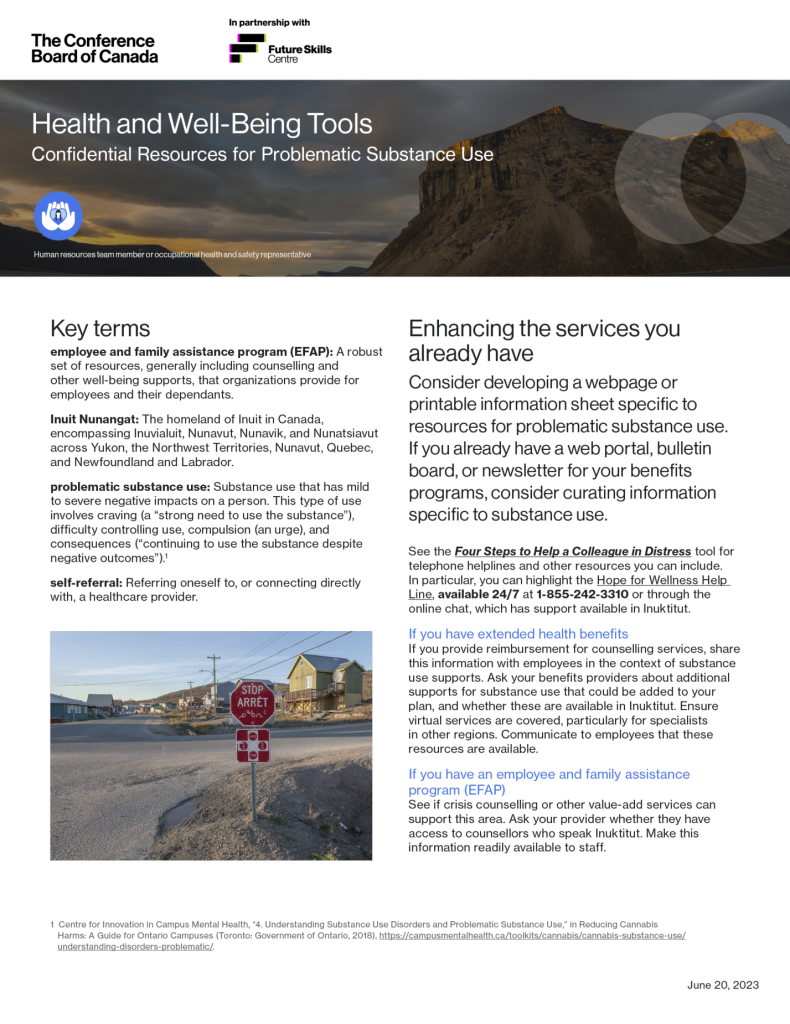
Community access to mental health and supports for those with aangajugasuarniq problems helps recruitment and retention in the workplace. A 2020 Kivalliq labour market analysis showed that resources for mental health and problematic substance use are among the major issues to address as preconditions for Inuit employment.
Inuit have less access to a regular medical doctor than other Indigenous people in Canada as doctors often aren’t available where Inuit live, and Inuit also experience gaps in aftercare. A 2021 survey found that 21 per cent of Inuit were likely to report an unmet need for healthcare services in the first year of the pandemic, while 13 per cent experienced discriminatory healthcare practices—nearly double that reported by First Nations people.
But resources are available for workplaces to provide enhanced support to employees who want to address substance use problems. Immediate actions include sharing existing EFAP and benefits information and building relationships with local providers. Companies that want to go further can implement virtual programs.
Inuit face stigma when disclosing problematic substance use and other mental illness concerns in small communities. Further, some Inuit may find that non-Inuit counsellors don’t align with their world view. Addressing these confidentiality concerns, this resource includes virtual workplace supports, as well as ways to enhance existing programs and services. Inuit values include pijitsirniq, and many of these supports can extend to family or be shared within the community.
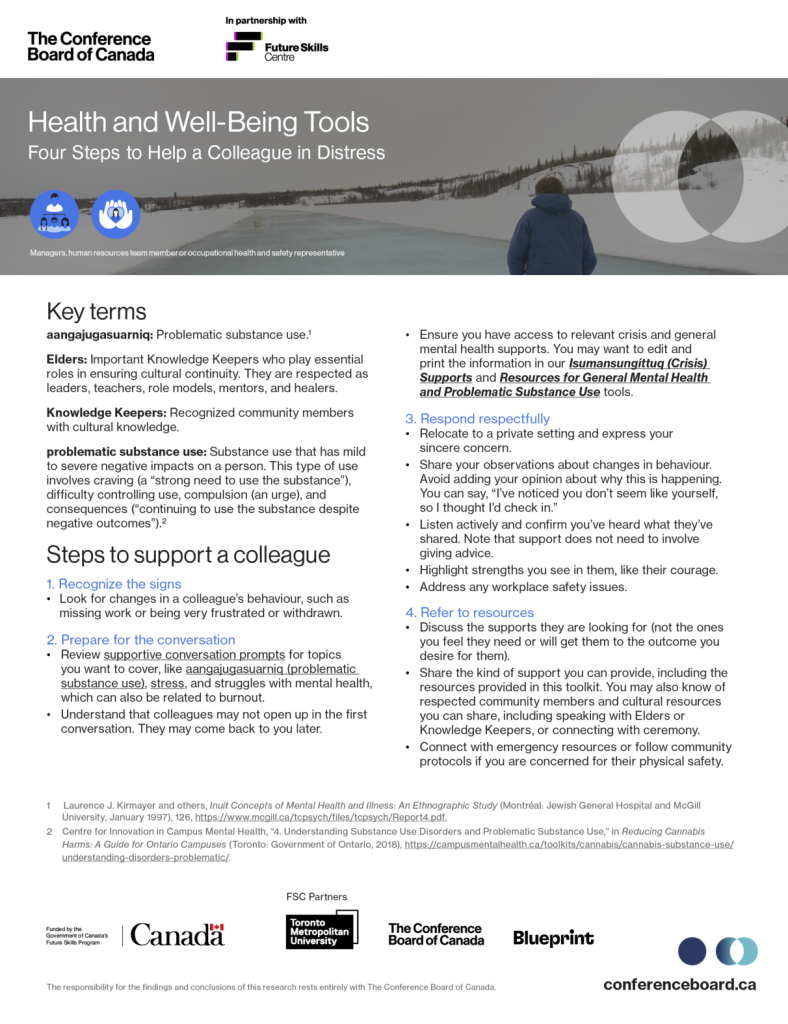
Four steps to help a colleague in distress
Tools for:
Managers
Human resources team member or occupational health and safety representative
Read the toolkit
Health and Well-Being Tools: Four Steps to Help a Colleague in Distress
June 20, 2023
Key terms

legal duty: An obligation, created by law or contract.
psychological safety: A shared perception among individuals of the consequences of taking interpersonal risks in a particular context such as a workplace.
Employers can use and share this tool with team members and build the team’s capacity to support one another and respond when they recognize signs of distress. Team members can also share crisis and general mental health supports with their families and communities.
Supervisors may have a legal duty to inquire when an employee’s behaviour affects the workplace. Employees are protected by human rights legislation from discrimination on the basis of disability, including mental illness, addictions, and chronic health concerns. When an employer reasonably should be (or is) aware that a disability is affecting an employee’s performance, the employer may have a duty to inquire to support the employee. Review the legislation for your area and use these tools to prepare for these conversations.
Isumansungittuq (crisis) supports
Tools for:
Managers
Human resources team member or occupational health and safety representative

Key terms
isumansungittuq: A temporary mental health issue.
The final step of the Four Steps tool involves referring a colleague to resources. The information in this tool is a list of crisis resources tailored to your region. These resources can be shared in the organization by HR, or a manager can share the resources with their team. They can also be printed and posted on your office bulletin board.
Resources for Piusirsungittuq (general mental health) and aangajugasuarniq (problematic substance use)
Tools for:
Managers
Human resources team member or occupational health and safety representative

Key terms
aangajugasuarniq: Problematic substance use.
piusirsungittuq: A person who is not acting like themselves.
problematic substance use: Substance use that has mild to severe negative impacts on a person. This type of use involves craving (a “strong need to use the substance”), difficulty controlling use, compulsion (an urge), and consequences (“continuing to use the substance despite negative outcomes”).*
*Centre for Innovation in Campus Mental Health, “4. Understanding Substance Use Disorders and Problematic Substance Use.”
The information in this tool is a list of general mental health resources tailored to your region, as well as information to help employees dealing with problematic substance use. These resources can be shared in the organization by HR, or a manager can share the resource with their team. They can also be printed and posted on your office bulletin board.
Resources
Training Opportunities to Share With Managers
Confidential Resources for Problematic Substance Use
Four Steps to Help a Colleague in Distress
Isumansungittuq (Crisis) Supports
Resources for General Mental Health and Problematic Substance Use
Workplace Learning
Recognizing the diversity of Indigenous communities
Indigenous Peoples across the territory currently known as Canada are diverse. First Nation, Métis, and Inuit are constitutionally recognized groups in Canada. But within these groups are distinct cultures, languages, regions, and economic circumstances. We recognize these distinctions, and the reader should understand that the recommendations of this toolkit do not necessarily reflect the views of all Indigenous Peoples in Canada.

This set of tools will help managers and human resources (HR) practitioners bring Inuit perspectives into training and professional development.
The set of tools begins with context that explains why incorporating Inuit values in training is an important way to build on existing Inuit skills, talents, knowledges, and competencies. Next, we show how to embed these values directly in workplace learning objectives for training programs. This information can be shared with internal trainers or vendors to increase the relevance of their teaching content and methods for an Inuit audience.
Then, we share practical guides that support managers with career navigation and performance conversations. These guides incorporate Inuit culture and values so that managers can have respectful and informed conversations with Inuit employees.
Incorporating Inuit perspectives and values into workplace learning
Tools for:
Human resources team member or occupational health and safety representative
Read the toolkit
Workplace Learning and Career Navigation Tools: Incorporating Inuit Perspectives and Values in Workplace Learning
June 20, 2023
Key terms

Inuit Nunangat: The homeland of Inuit in Canada, encompassing Inuvialuit, Nunavut, Nunavik, and Nunatsiavut across Yukon, the Northwest Territories, Nunavut, Quebec, and Newfoundland and Labrador.
pilimmaksarniq/pijariuqsarniq: “Development of skills through observation, mentoring, practice and effort.”*
self-actualization: A state of being in which a person can take full advantage of their strengths and creativity to be the best version of themselves.
*Government of Nunavut, Public Service Annual Report 2020–21, 4.

Training and professional development help create and sustain high-performing workplaces. Strong learning cultures result in greater returns on investment, including superior employee performance, customer satisfaction, and higher-quality products. The training budget of workplaces in Inuit Nunangat should include training that incorporates Inuit values to ensure that the training is relevant to Inuit employees and builds cultural awareness for non-Inuit employees.
Inuit believe the purpose of building skills is to share expertise to benefit the community. Employers need to understand this belief to deliver workplace training to Inuit employees. A learning environment focused on competition isn’t culturally appropriate—instead, build a collaborative environment.
Research participants in our project emphasized that workplace learning educators need to incorporate Inuit values in their content and teaching methods. Inuit want learning to be rooted in community, the land, and holistic well-being, encompassing physical, social, environmental, and economic knowledge. Whenever possible, workplaces in Inuit Nunangat should include Inuit trainers and cultural experts to help deliver training that incorporates Inuit values. This approach also builds cultural awareness for non-Inuit employees.
Workplace learning objectives
Tools for:
Human resources team member or occupational health and safety representative
Read the toolkit
Workplace Learning and Career Navigation Tools: Inuit Perspectives in Workplace Learning
June 20, 2023

This tool includes examples that show how to embed Inuit values in your content on workplace learning—specifically, your learning objectives. When you embed Inuit values in workplace learning, you honour existing Inuit skills, talents, knowledges, and competencies. You can incorporate Inuit Societal Values in learning delivery, even when your training is highly technical.
Career navigation conversation guide
Tools for:
Managers
Human resources team member or occupational health and safety representative

Read the toolkit
Workplace Learning and Career Navigation Tools: Manager–Employee Career Discussions
June 20, 2023

This tool includes conversation guides for career navigation and performance. Understanding how to develop and retain Inuit personnel is an important step to meeting your organization’s goals for reconciliation, diversity, Inuit engagement, and Inuit Impact and Benefit Agreements. You can take action in these areas by learning how to have conversations that have a clear intent, build trust, celebrate success, and outline next steps.
In 2022, chief executive officers shared that retention is one of their top internal priorities. In particular, they highlighted the goals of strengthening the internal leadership pipeline, developing workforce capabilities, and building a resilient workforce to prepare for future challenges. Managers can use the downloadable conversation guides, Career Navigation and Performance Conversations, to further this vision for Indigenous and non-Indigenous employees.
Research participants in our project emphasized that Inuit need pathways for career development. Inuit need to be in decision-making roles or have opportunities to provide input into decision-making processes. However, taking on leadership roles at work can create challenges for how Inuit are viewed in the community since communities are small and supervisors may be managing people they know well. As a result, Inuit employees may want alternative methods of recognition, lateral moves, or informal leadership opportunities. Open career navigation discussions are critical for Inuit employees.
Performance conversations
Tools for:
Managers
Human resources team member or occupational health and safety representative
Read the toolkit
Workplace Learning and Career Navigation Tools: Performance Conversations
June 20, 2023
Key terms
pijitsirniq: “Serving and providing for family and/or community.”*
*Government of Nunavut, Public Service Annual Report 2020–21.
Performance conversations help retain an employee in the right role. Through open dialogue about expectations, performance conversations ensure that employees align with their role and desired outcomes. These conversations should be seen as a learning opportunity for both managers and employees. Community, family, and cultural priorities factor into work–life integration for Inuit. Pijitsirniq is an important element to bring into conversations about Inuit employee performance and career development.
Integrating Inuit Societal Values into workplace policies and practices can help managers become more culturally aware, enabling them to identify biases and build trust. They should give feedback in private, not in front of a group, and encourage employees to be in situations in which they can successfully do the same. When appropriate, such as for a low-risk, high-urgency decision, managers can encourage teams to decide collectively how best to handle decisions.
Resources
Incorporating Inuit Perspectives and Values in Workplace Learning
Inuit Perspectives in Workplace Learning
Manager–Employee Career Discussions
Performance Conversations