


Benefits and Challenges
of Hybrid Work
Advice for organizations considering hybrid work
A hybrid workplace model is defined as a flexible workplace arrangement that includes both in-office and remote work.
Benefits

Acceleration of technology
The pandemic served as a catalyst for stronger use of technology and digitization of many processes. Organizations see this digital transformation as an opportunity to move more services online, enhance service quality, increase accessibility, and provide more flexibility to their customer-focused strategy.

Shared workspaces
Hybrid work plans commonly use shared workspaces. Essentially, the workstation is static and the occupants are dynamic—no one has an assigned office or seat. Shared office layouts can be designed to facilitate unstructured collaboration and communication within and across teams.

Social connection
Combining on-site and off-site work arrangements will help combat virtual meeting fatigue while reducing the loneliness and isolation that many experience when working remotely. A hybrid workplace model may support mental health and wellness for employees and customers, as they are able to socialize on-site without losing workplace flexibility.

Reduction of office space
With the implementation of a hybrid work model, organizations can revisit their office layout. This could save an average of 30 per cent of real estate costs due to less space and maintenance.1
- Antonio De Luca Ancillo, Maria Teresa de Val Nuñez, and Sorin Gavrila Gavrila, “Workplace Change Within the COVID-19 Context: A Grounded Theory Approach,” Economic Research 34, no. 1 (2021).
Challenges
Acceleration of technology
Hybrid workplace models can be more challenging when it comes to scheduling and coordination of team members. Managing schedules for customer-facing job functions will require additional planning within and across teams.
Employee inclusivity
In hybrid workplaces, leaders need to be mindful of including remote team members when holding an on-site meeting by ensuring that all employees, whether on-site or remote, have opportunities to speak and participate.
Technological challenges
To support a hybrid workforce, training and support relating to technology should be provided to all employees.

Recommendations for Hybrid Workplaces
Embrace the Opportunity to Redefine Workplace Culture
Transitioning to a hybrid workplace model will provide organizations with an opportunity to redefine their workplace culture. Transparency and clear communication when redefining workplace values and culture can give employees a sense of excitement and a renewed purpose. To encourage employee engagement, it is imperative that leaders collaborate with their employees on how to build and contribute toward a new workplace culture.
- Reconsider and update company values to align with hybrid workplace conditions.
- Recognize that the workplace will be everchanging.
- Maintain strong relationships and cross-functional team collaboration as a top priority through redefined company values.
Focus on Key Performance Indicators and Employee Accountability
Continuing to enhance, update, and modernize customer services is important for the success of a hybrid workplace model. A digital transformation strategy needs to consider the requirements for the IT infrastructure, cyber security, digital skills development, workforce planning, digitize processes, and the biggest opportunities for service automation.
- Digitize services that are of primary interest to the public, such as online self-serve for recreational bookings, ordering blue bins, submitting job applications, and paying taxes.
- Introduce digital software platforms to increase community engagement.
- Provide training to staff on new technologies and digital processes.
- Consider hiring additional application support and information technology staff to support remote workers.
- Collaboration tools should be implemented that both help employees to stay engaged and help to meet organizational priorities.
Incorporate Different Forms of Flexibility
Organizations that provide different blends of services are unique, making it impossible to provide all employees with the same type of remote work options. Some job functions require on-site performance, and so it is vital to incorporate different forms of flexibility that will also benefit those employee groups. Consider taking a flexible approach that is not overly regimented, while balancing operational needs for the business to remain successful.
- Offer flexible work options to employees in roles ineligible for hybrid work.
- Communicate criteria for eligible remote and hybrid positions.
- Fully leverage technology to automate certain activities in each role and redesign roles based on efficiency gains.
Communicate Residential Expectations
Organizations should establish policies that indicate whether employees must live within a certain radius of the main office, depending on their roles and responsibilities. Perhaps only those working in fully remote positions should be given the flexibility to work anywhere within the province.
- Hybrid workplace policies need to communicate the geographical radius from the on-site workplace within which an employee must reside.
- Employees in all positions must know whether they are permitted to move further away within the same province or if they are able to move anywhere within Canada as long as they adhere to established work hours.

Be Proactive in Engaging Stakeholders
Organizations need to be proactive in engaging key stakeholders—including customers, unions, and shareholders—as part of the change process. A communication strategy with key messages for all stakeholder groups should be developed prior to, and upon re-entry to, the onsite workplace.
- Perform proactive outreach through impromptu calls or outreach to forge social connections with key stakeholders.
- Human resources can require leaders to include in their engagement plan an approach to sustain social connections and collaborations.
- Create a change management strategy to communicate benefits for each audience group to increase trust and change adoption for key audiences.
- Encourage the use of various technology platforms for employee engagement, such as Google Hangout Rooms, Slack channels, Asana, and Microsoft Teams.
Coach Management on New Leadership Skills
For leaders who have spent years managing in an office setting, the change to a hybrid workplace model will come with challenges and uncertainties. Leaders should be provided with training and coaching to learn how to create culture and lead virtually. Professional coaches can be brought in to support senior leaders who are learning to lead effectively in the new hybrid workplace. This coaching may address topics such as creating emotional engagement with employees remotely through the expression of empathy, or how to coach and mentor staff remotely.
- Train leaders on performance management remotely and how to communicate/manage remotely.
- Role model health and wellness values, and have leaders encourage employee participation in mental health and wellness programs.
- Hold space for personal conversation at the start of each meeting, so that colleagues feel comfortable taking the time to get to know one another.
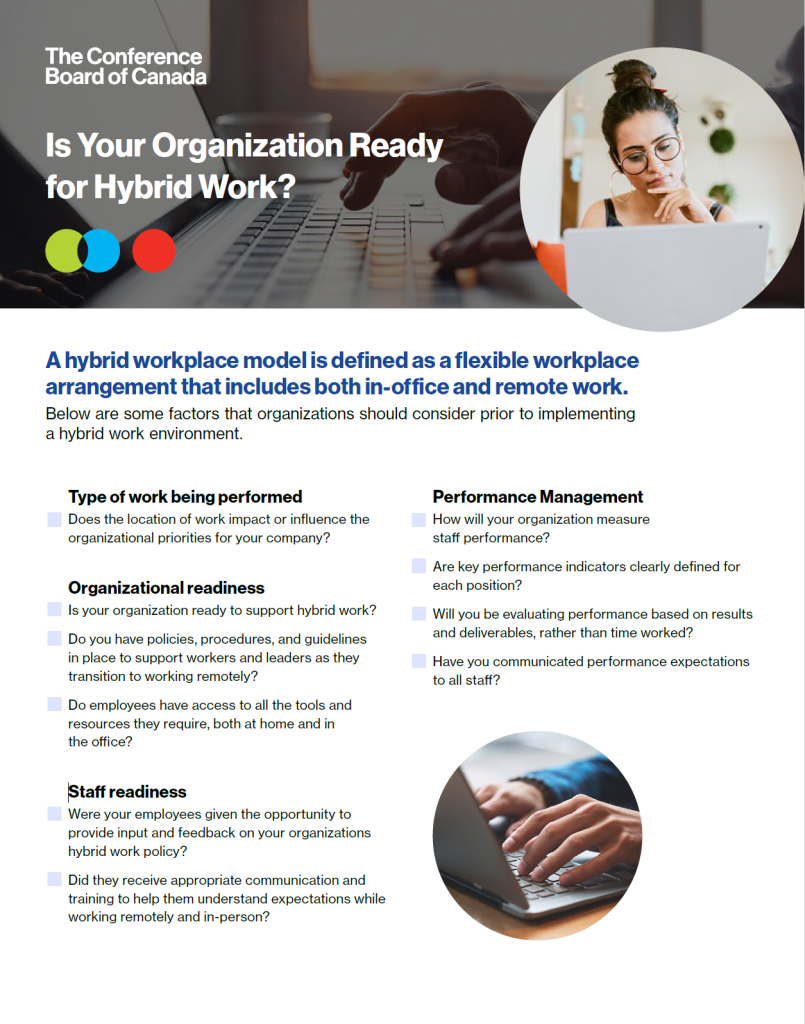
Read the summary for executives
Is Your Organization Ready for Hybrid Work?
May 2, 2022 • 2-min read
Read the impact paper
Workplaces for the Future: A Playbook for Municipal Leaders on Exploring Remote, Hybrid, and On-Site Models
October 25, 2021 • 57-min read
Disclaimer:
The responsibility for the findings and conclusions of this research rests entirely with Signal49 Research.