

Indigenous Economic Realities
A $104-Billion Opportunity for Indigenous Economic Involvement
April 14, 2026
Key findings
- There are 104 major projects in Natural Resources Canada’s 2024 Major Projects Inventory worth over $104 billion located on or within 15 kilometres of Indigenous lands.
- Energy infrastructure dominates the list of proposed projects, with $95 billion across 79 projects, including hydro, transmission, liquefied natural gas, wind, solar, biomass, and energy storage.
- At least 22 projects—worth over $23 billion—include Indigenous equity partners, reflecting an important role for Indigenous ownership and governance.
- Indigenous equity is most visible in clean energy but remains rare in mining projects despite geographic proximity to Indigenous lands.
- Shared ownership, not just consultation, is key to long-term success—accelerating project timelines should not come at the expense of Indigenous economic involvement.
Our review of geospatial data from Natural Resources Canada’s 2024 Major Projects Inventory found that of 377 active or planned projects in the Inventory’s subset of geolocatable projects, 104 are on or within 15 kilometres (km) of Indigenous lands. These include hydro, mining, energy transmission, and critical minerals projects in every province and territory. These projects account for more than $104 billion in estimated capital investment—representing over 20 per cent of a total $505 billion in geolocatable projects. (Download the Methodology for details on our research approach.)
While our research highlights $104 billion in major projects for Indigenous economic involvement, this figure is likely a conservative estimate. Many projects have indirect or cumulative impacts on Indigenous territories that may not be fully captured through proximity-based methods alone. Further research, including deeper spatial analysis and Indigenous-led validation, will likely reveal even greater levels of overlap and shared interest.
Summary of major projects on or near Indigenous lands
Among the 104 major projects in focus, energy projects represent over 90 per cent of the total value, or $95 billion out of $104.7 billion in capital. (See Chart 1.) These include transmission lines, hydroelectric expansions, liquefied natural gas (LNG) terminals, battery storage facilities, and renewable energy developments. The mining sector accounts for $9.3 billion, while forestry and bioeconomy projects represent a much smaller share, totalling approximately $360 million.
Chart 1
Capital investment by sector
(2024 C$ billions)
Sources: Natural Resources Canada; Signal49 Research.
Just over $72.4 billion across the 104 major projects is associated with those still in the planning stage as of September 2024, highlighting the critical importance of early-stage Indigenous engagement and equity negotiations. The remaining $32.3 billion is linked to projects already under construction, many of which include major clean energy developments, transmission upgrades, and mining operations.
Energy sector deep dive: Where the dollars are going
The $95 billion in highlighted energy projects span clean power generation, transmission, LNG infrastructure, and energy storage systems across nearly every province and territory.
Twenty of the 79 energy projects—roughly one in four—involve some form of Indigenous equity participation. While the remaining 59 projects may involve consultation or benefit agreements, they did not disclose Indigenous equity ownership or co-development at the time our research was conducted. The numbers underscore an uneven landscape of ownership, even as Indigenous Nations continue to push for greater inclusion in clean energy development.
Within the energy sector, projects are heavily concentrated in clean energy. (See Chart 2.) Over $31.6 billion is tied to renewables and non-emitting technologies. The largest share, $21 billion, is in hydroelectric transmission and generation projects such as Wataynikaneyap in Northern Ontario and Site C in Northern British Columbia. Wind projects account for $6.4 billion, while bioenergy initiatives total $3.2 billion—including Indigenous-led biomass and waste-to-energy facilities in British Columbia, Alberta, and the Northwest Territories. Smaller subsectors include geothermal ($330 million) and solar ($180 million), with several new developments led by or in partnership with Indigenous Nations.
Chart 2
Capital investment by clean energy type
(2024 C$ billions)
Sources: Natural Resources Canada; Signal49 Research.
These investments reflect a critical shift in Canada’s energy economy—one that is increasingly tied to clean power, energy transition mandates, and Indigenous land stewardship. Yet the data also reveals that while Indigenous economic involvement is growing in certain clean tech areas, ownership remains concentrated in a minority of projects. Transmission infrastructure, LNG terminals, and some hydro expansions still proceed without Indigenous equity involvement, even when located near or across Indigenous jurisdictions.
Targeted investment strategies—especially those that combine equity, clean energy innovation, and local capacity-building—will be essential to closing this participation gap and ensuring that Indigenous Nations are not just consulted but fully included in the energy transition.
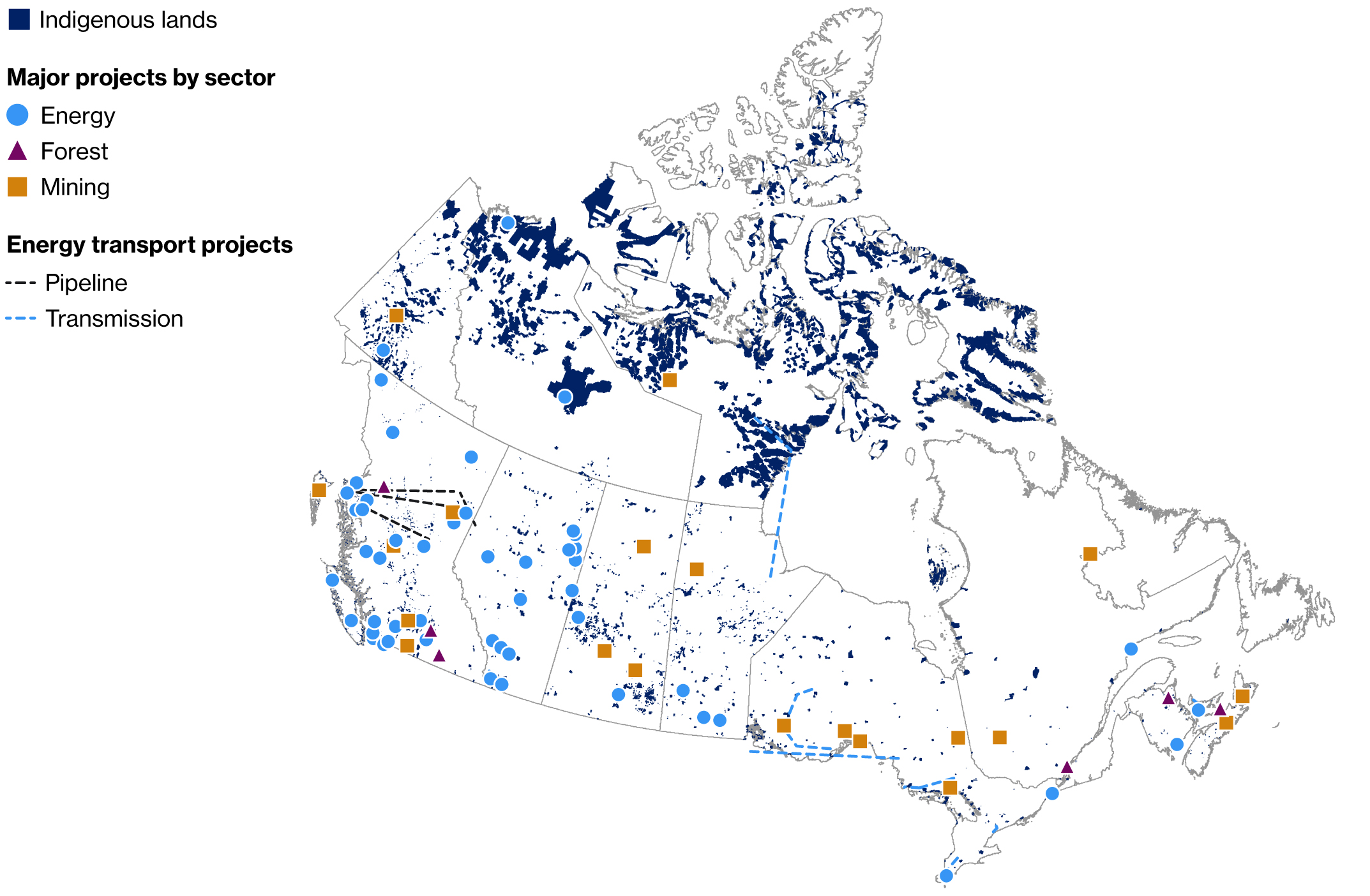
The geographic spread of major projects on or within 15 km of Indigenous lands is highly uneven, both in number and in value. (See Exhibit 1.) British Columbia stands out as the national leader on both fronts. Of the 104 projects analyzed, 44 are located in that province, representing more than 60 per cent of total project value—approximately $66.6 billion. These include some of the country’s largest infrastructure developments, such as Site C, Cedar LNG, and numerous transmission, hydro, and renewable energy projects, many of which intersect with unceded Indigenous territories and involve active Indigenous partnerships or negotiations.
Alberta and Ontario each account for 15 projects but differ substantially in scale. Alberta’s project list—largely composed of oil sands, wind, and renewable fuels infrastructure—totals $16.1 billion, or just over 15 per cent of total value. Ontario’s projects, which include major transmission upgrades and clean energy expansions, represent $9.1 billion, or approximately 8.7 per cent of the total.
Next in line, Saskatchewan and Quebec each host five projects, with comparable total values around $4.2 billion. The remaining provinces and territories, and several multi-jurisdictional corridors, each contribute smaller totals, generally under 1 per cent of the 104 major projects’ total value. While project counts may be low in these regions, the potential impacts on nearby Indigenous communities—especially those in remote areas—can be profound. For example, the Inuvialuit Petroleum Corporation is leading the $160-million Inuvialuit Energy Security Project to construct a natural gas processing facility and LNG gas plant near Tuktoyaktuk, Northwest Territories. The project will provide cleaner, locally sourced energy to replace diesel in Inuvialuit communities, lowering emissions and improving energy reliability. It represents a major step toward Indigenous energy sovereignty and long-term economic development in the region.1
The geographic distribution of projects illustrates not only where Canada’s infrastructure investment is concentrated, but also where the risks and opportunities for Indigenous involvement are most acute. A regionally tailored approach to policy, investment, and engagement is essential to reflect this uneven geography.
Exhibit 1
Map of 104 major projects on or within 15 km of Indigenous lands
Sources: Natural Resources Canada; Signal49 Research.
Download the data to see a list of all projects.
- Inuvialuit Regional Corporation, “Inuvialuit Energy Security Project,” Inuvialuit Regional Corporation, accessed September 8, 2025, https://irc.inuvialuit.com/inuvialuit-energy-security-project/.
Indigenous governments are not merely stakeholders—they are landholders, rights-holders, and increasingly, equity partners. Across Canada, Indigenous people are leading or co-developing major infrastructure projects that reflect not only legal and territorial jurisdiction, but also economic vision and innovation. Of the 104 projects on or within 15 km of Indigenous lands, 22 include Indigenous equity participation, with a combined capital value exceeding $23 billion (total project value, not equity value). Indigenous lands and governance are increasingly intertwined with Canada’s infrastructure economy.
From coast to coast to coast, Indigenous people are showing how project development can be done differently. They are building economic resilience and community wealth through partnerships that integrate environmental governance, benefit-sharing, and long-term capacity building.1
Examples from the current project landscape illustrate this shift:
- Atlin Hydro (British Columbia): This $200-million clean energy project is 100 per cent Indigenous-owned by the Taku River Tlingit First Nation. It delivers renewable power into the Yukon grid and represents a model for Indigenous-led climate transition projects.2
- Pe‑Na‑Koyim Wind Project (Alberta): This on-reserve wind farm is a partnership between the Blood Tribe (Kainai Nation), Indigena Capital, and EDF Renewables—marking Alberta’s first industrial-scale wind development led by a First Nation. The project will generate up to 300 megawatts of clean electricity, with long-term revenue, jobs, and governance capacity for the Nation. It also provides renewable energy to Alberta’s grid, supports local economic growth, and enables industry partners to meet sustainability and environmental, social, and governance targets through Indigenous-led development.3
- Wataynikaneyap Transmission Project (Ontario): Spanning 1,800 km of new transmission lines, this project connects 17 fly-in First Nations to the Ontario power grid. With majority Indigenous ownership, it exemplifies partnership-based development in remote regions.4
- Woodfibre LNG Project (British Columbia): Located near Squamish, this multi-billion dollar LNG export facility is being developed in close partnership with the Sḵwx̱wú7mesh Úxwumixw (Squamish Nation), which has negotiated an unprecedented environmental assessment agreement and held direct economic interests through employment, procurement, and environmental monitoring. The project reflects a model of Indigenous-informed development that delivers regional economic growth, energy export capacity, and emissions reduction benefits via lower-emission LNG production powered by hydroelectricity. It also supports industrial customers in Asia transitioning from coal to cleaner fuels.5

However, this growing economic role is unevenly distributed—both geographically and by sector. British Columbia is the national leader, with 44 projects accounting for nearly 64 per cent of total project value. It also has the highest concentration of Indigenous equity partnerships, supported by a landscape of modern treaty governments, unceded territories, and numerous Indigenous-owned businesses and Indigenous-led partnerships. Equity participation is also visible in Alberta, where Nations like the Blood Tribe are co-leading clean energy ventures, and in Ontario, where transmission infrastructure such as the Wataynikaneyap Project is majority Indigenous-owned. Elsewhere, however, formal equity arrangements with Indigenous owners remain rare—particularly in the mining and critical minerals sector.
This unevenness extends across sectors. In the energy space, Indigenous equity is most pronounced in clean energy developments. Of the $95 billion in capital tied to energy projects, over $22 billion is linked to projects that include Indigenous equity. These include hydroelectric expansions, wind farms, biomass facilities, and transmission lines—technologies closely aligned with land stewardship, local employment, and community ownership.
As Canada looks to build the infrastructure required to diversify its economy and strengthen trade beyond the United States, the urgency to act should not come at the expense of Indigenous involvement. Even as projects move at the “speed of opportunity,” they have both legal obligations and relational standards to uphold in consultation and partnership with Indigenous rights holders.6 Such standards have been shaped by decades of best practice—through impact and benefit agreements, resource revenue-sharing arrangements, settlement processes, and legal precedents recognizing Indigenous rights and title. Getting this balance right is not only a legal requirement—it is also foundational to Canada’s long-term economic resilience and reconciliation.
Our next installment in this series turns from projects to people and places. It introduces a practical readiness lens—grounded in clear, comparable indicators—that shows where Indigenous communities are today and what economic roles they’re best positioned to play. Using this lens, decision-makers can match opportunities to local capacity and sequence supports in the right order: procurement pathways and equity partnerships where benches are deep; targeted training and supplier development where teams are emerging; and foundational investments in housing, transport, and broadband where basic conditions must be addressed first. In short, we set out how to convert proximity into partnerships—so that the billions in future major projects yield meaningful and lasting benefits for Indigenous economic involvement.
- Matthew Belliveau, “Indigenous Ownership: Best Practices for Major Project Success,” The Conference Board of Canada, March 8, 2023.
- Amanda Thompson, “The Atlin Hydro Project: Making a Meaningful Contribution to Community Health and Well-Being,” The Conference Board of Canada, January 27, 2021, https://www.signal49.ca/product/the-atlin-hydro-project-making-a-meaningful-contribution-to-community-health-and-well-being/.
- Impact Assessment Agency of Canada, “Pe-Na-Koyim Wind Project,” Impact Assessment Agency of Canada, last modified May 26, 2023, https://iaac-aeic.gc.ca/050/evaluations/proj/84516.
- Watay Power, “Line that brings light. Powering our future,” Watay Power, accessed July 20, 2025, https://www.wataypower.ca/.
- Squamish Nation, “Major Projects,” Squamish Nation, accessed July 20, 2025, https://www.squamish.net/divisions/territory-culture-services/rights-title/major-projects/.
- Babatunde Olateju and others, Corridors of Prosperity: Transforming the Future of Canada’s Trade Infrastructure Network, The Conference Board of Canada, 2025, https://www.signal49.ca/product/the-future-of-canadas-trade-infrastructure-network_jun2025/.
The methodology and data sources are detailed in our technical report:
Access a list of major projects reviewed for this research: