


Mapping Indigenous Export Potential
The Intersection of Indigenous Self-Employment With Canada’s Export Economy

Français • March 31, 2026
Why do this work
Participation in industries connected to international markets is strongly associated with long-term economic strength. Industries with sustained export activity tend to demonstrate higher productivity, greater resilience to economic disruptions, and stronger growth over time, making export participation an important indicator of long-term economic positioning.1
This focus aligns directly with the Truth and Reconciliation Commission’s Calls to Action that address Indigenous economic participation, particularly Call to Action 92 (business and reconciliation) and Call to Action 7 (economic opportunities).2 Current self-employment patterns show, however, that Indigenous participation in export-engaged industries is both limited and declining.3 Addressing this gap between economic potential and observed participation is a central motivation for this research.
What we mean by export-engaged industries
We use two related terms:
- Export-oriented industries are those industries in which at least 50 per cent of revenues come from exporting.
- Export-intensive industries are those industries in which greater than 40 per cent but less than 50 per cent of revenues come from exporting.
Together, these industries are referred to as export-engaged industries.
Table 1
Export intensity by industry
(share of revenues from export sales, 2016, per cent)
| Export-intensive industries | |
|---|---|
| Plastics and rubber products manufacturing | 42.8 |
| Wood product manufacturing | 47.0 |
| Farms, fishing, hunting, and trapping* | 47.6 |
| Electrical equipment, appliance and component manufacturing | 48.3 |
| Furniture and related product manufacturing | 48.8 |
| Export-oriented industries | |
|---|---|
| Fabricated metal and machinery* | 57.1 |
| Oil and gas extraction | 58.5 |
| Transportation equipment manufacturing | 59.8 |
| Paper manufacturing | 60.3 |
| Clothing and textiles* | 61.7 |
| Primary metal manufacturing | 68.8 |
| Miscellaneous manufacturing | 70.4 |
| Chemical manufacturing | 81.2 |
| Computer and electronic product manufacturing | 98.4 |
| Mining and quarrying (except oil and gas) | 99.0 |
*clusters of export-intensive industries (see methodology)
Sources: Signal49 Research; Statistics Canada, Quarterly Survey of Financial Statements; Innovation, Science and Economic Development Canada, Trade Data Online; Statistics Canada, Table 36-10-0007-01.
Data and approach
We examine Indigenous exports using 2001 and 2021 data as these census cycles offer consistent, nationally comparable indicators suitable for long-term analysis. Trends in self-employment and sector participation tend to change gradually, so patterns observed over this period remain useful for understanding the structure of Indigenous involvement in export-engaged industries.
The inclusion of 2021 data, collected during the COVID-19 pandemic, also provides a reference point for how Indigenous enterprises responded to a major economic disruption, helping to interpret longer-term changes in participation across sectors. However, 2021 data should be interpreted cautiously given pandemic-related restrictions that contributed to incomplete enumeration on some reserves and settlements, meaning some Indigenous communities are not captured in 2021 Census tabulations.4
Why this matters for Indigenous SME exporters and Canada
For small and medium-sized enterprises (SMEs), participation in export-engaged industries can support long-term sustainability by expanding access to global markets, diversifying revenue sources, and reducing reliance on small or remote local markets. Indigenous-owned SMEs operating in export-engaged industries tend to be more resilient and achieve higher growth than those serving only domestic markets, yet the Indigenous export rate (7.2 per cent) remains well below the Canadian average (12.1 per cent).5 Export engagement represents an opportunity for growth and a narrowing of a considerable participation gap for Indigenous enterprises.
Export-engaged industries are also central to community-owned Indigenous enterprises, particularly in resource-based sectors such as forestry, mining, and energy. Export revenues from these industries generate own-source income that supports infrastructure, education, and social programs, aligning economic activity with community priorities.6
For Canada, increasing Indigenous participation in export-oriented and export-intensive industries strengthens overall export capacity, supports economic diversification in rural and Northern regions, and helps ensure the benefits of trade are more broadly shared.7 Expanding Indigenous SME participation in export-engaged industries also advances reconciliation by translating commitments under the Truth and Reconciliation Commission’s Calls to Action into tangible economic outcomes.8
The sections that follow describe one overarching pattern: Indigenous self‑employment has grown rapidly, but most of that growth has been outside export‑engaged industries, especially outside land‑based sectors (such as hunting and fishing), and with sharp regional, gender, and identity differences. The dashboards are designed to show where export activity was concentrated in 2021, where it was declining, and how these distributions vary across regions and sectors.
Growth in numbers, decline in share
Indigenous self‑employment in export‑intensive industries rose across the provinces from 2001 to 2021 (the latest data available) but fell in the territories. Export‑oriented sectors showed the same pattern. Nationally, about 84,000 Indigenous people were self‑employed in 2021; 6.7 per cent worked in export-intensive industries and 1.7 per cent in export‑oriented industries—meaning only 8.4 per cent of Indigenous entrepreneurs operate in export‑engaged industries.
Over 2001–2021, total Indigenous self-employment grew by 358 per cent, while the number of self-employed Indigenous people in export-intensive industries grew by 65.6 per cent. As a result, the share of Indigenous entrepreneurs working in export-intensive industries fell from 14.6 per cent to 6.7 per cent. In short, more Indigenous entrepreneurs are in export-engaged industries than before, but these industries now make up a much smaller slice of overall Indigenous self-employment. This shift should be interpreted within the context of the COVID-19 period. Pandemic conditions reshaped entrepreneurship toward more necessity-driven and fewer high-growth starts while exports also fell, dampening growth in export-engaged self-employment.9
Growth in export-intensive Indigenous self-employment came mainly from a 66 per cent increase in land-based sectors (which refers to farming, fishing, hunting, and trapping), including both on and off reserve. In export-oriented industries, self-employment in oil and gas extraction rose about 14-fold, and clothing and textiles more than doubled. A notable contextual factor is that major energy projects such as oil sands facilities are sometimes accompanied by impact and benefit agreements that can include training, employment, and other economic benefits for First Nations, which could align with increased Indigenous contracting/self-employment activity in work related to oil and gas.10
Land-based sector dominates in 2021

Land-based sectors led export-intensive industries across all provinces and territories with available data. This dominance aligns with the importance of land-based activities in Indigenous economies.11 Export-oriented industries show a more balanced mix; nationally, oil and gas extraction and miscellaneous manufacturing lead. Miscellaneous manufacturing includes companies manufacturing a diverse range of products, such as medical equipment and supplies, jewellery, sporting goods, toys, and office supplies.12
In export-intensive industries, most self-employed Indigenous workers report college or a trades certificate/diploma as their highest level of education, with a smaller share holding university credentials, particularly in land-based sectors. In export-oriented industries, education profiles are more varied: miscellaneous manufacturing includes self-employed workers at every level of education, while sectors such as chemical manufacturing are made up mainly of those whose highest education is high school or college.
Nationally, Indigenous men hold 70 per cent or more of self-employment roles across export-intensive industries. In export-oriented industries, Indigenous women constitute close to 50 per cent of workers in miscellaneous manufacturing and the majority of workers in clothing and textiles.
Indigenous export self-employment is declining
From 2001 to 2021, the on-reserve share of self-employment in export-intensive industries plunged, and export-oriented industries became only a sliver. The main driver was an approximately 35 per cent drop in on-reserve Indigenous self-employment in land-based sectors—from approximately 1,100 workers to just under 700—even as on-reserve Indigenous self-employment in all other industries nearly doubled. Statistics Canada’s Indigenous Peoples Survey showed a similar decline: Among First Nations youth and young adults who live off reserve, the share who hunted, fished, or trapped fell from 41 per cent in 2006 to 38 per cent in 2012 and 33 per cent in 2017.13 Off-reserve self-employment also shifted toward “all other industries,” and the export-intensive share declined from 2001 levels.
What we mean by Northern Canada
Our definitions of Northern and Southern Canada follow the Northern Development Ministers Forum definition of Canada’s North. As seen on the map in Exhibit 1, Northern Canada includes the three territories and the northern portions (above the red line) of seven provinces. Southern Canada includes the portions of the provinces that fall below the red line.
Exhibit 1
Northern regions of Canada
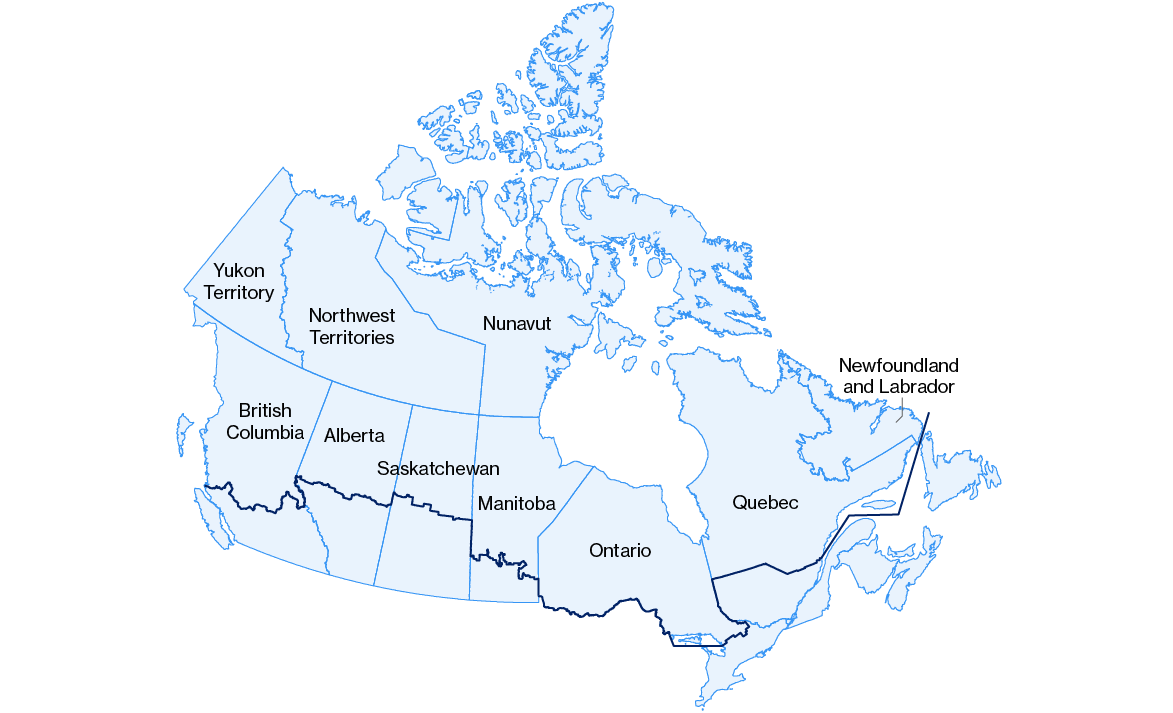
Sources: Signal49 Research; Northern Development Ministers Forum, 2001.
In the North, the share of businesses fell steeply in export-intensive industries and remains tiny in export-engaged industries. Two forces explain this finding: fewer self-employed people in land-based sectors, and a near-tripling of self-employment in all other industries. The South shows the same tilt toward other industries. Even though the number of self-employed people in export-engaged industries rose, growth was proportionally much stronger in all other industries.
Overall export-engaged Indigenous entrepreneurship hasn’t kept pace with overall self-employment growth.
Gender and identity differences
For self-employment in export-intensive sectors, land-based sectors led all industries, regardless of First Nations, Inuit, or Métis identity. Men held most roles in these industries, while women continued to lead in clothing and textiles. Far more Indigenous entrepreneurs in export-intensive sectors lived off reserve than on reserve.
Inuit men made up 13.6 per cent of export-intensive roles in 2021. Export-oriented sectors remained minuscule overall—usually around 1 to 2 per cent—and near zero for Inuit. However, few Inuit overall are self-employed, which can help account for these small numbers.
Nationally, within the 10 manufacturing categories we examined, Indigenous women represent 74 per cent of workers in clothing and textiles, 50 per cent in chemical manufacturing, and 47 per cent in miscellaneous manufacturing.
For a full description of sector contents, see the technical report.
What all this means for 2026
Taken together, the data tell a clear story. Indigenous self employment has expanded rapidly, but export engaged industries now make up a much smaller share of that total. Export intensive industries are still anchored in land based sectors even as they decline on reserve and in the North. These findings matter because export participation is linked to higher productivity, resilience, and growth and can generate own source revenues that support community priorities.14 These patterns show where targeted trade supports and investments could have the biggest payoff, especially on reserve and in the North.
The methodology and data sources are detailed in our technical report:
- Global Affairs Canada, “Trade Policy and Small and Medium-Sized Enterprises,” Government of Canada, last modified June 3, 2025, https://international.canada.ca/en/services/business/trade/policy/inclusive/small-medium-enterprises/policy; and Innovation, Science and Economic Development Canada, “SMEs at a Glance: Canadian Exporters,” Government of Canada, last modified July 11, 2025, https://ised-isde.canada.ca/site/sme-research-statistics/en/smes-glance-canadian-exporters.
- Truth and Reconciliation Commission of Canada, Truth and Reconciliation Commission of Canada: Calls to Action, Truth and Reconciliation Commission of Canada, 2015, https://nctr.ca/wp-content/uploads/2021/01/Calls_to_Action_English2.pdf.
- Global Affairs Canada, Canada’s State of Trade 2025: Small and Medium Enterprises Taking On the Export Challenge, Government of Canada, June 2025, https://international.canada.ca/en/global-affairs/corporate/reports/chief-economist/state-trade/2025.
- Statistics Canada, “Incompletely Enumerated Reserves and Settlements,” Statistics Canada, last modified August 12, 2022, https://www12.statcan.gc.ca/census-recensement/2021/ref/iers-repd-eng.cfm.
- Canadian Council for Aboriginal Business and Global Affairs Canada, Adàwe: Export Experiences of Indigenous Entrepreneurs, Government of Canada, October 18, 2023, https://www.ccib.ca/wp-content/uploads/2023/10/ccab_report_english_FINAL.pdf.
- Organisation for Economic Co-operation and Development, Linking Indigenous Communities With Regional Development in Canada, Organisation for Economic Co-operation and Development, January 21, 2020, https://www.oecd.org/en/publications/linking-indigenous-communities-with-regional-development-in-canada_fa0f60c6-en/full-report/enabling-rural-indigenous-entrepreneurship_d62755ae.html.
- Global Affairs Canada, Canada’s State of Trade 2025.
- Truth and Reconciliation Commission of Canada, Truth and Reconciliation Commission of Canada: Calls to Action.
- Innovation, Science and Economic Development Canada, The Impact of the COVID-19 Crisis on Business Startups and Entrepreneurial Activities in Canada, Government of Canada, last modified August 15, 2025, https://ised-isde.canada.ca/site/sme-research-statistics/en/research-reports/impact-covid-19-crisis-business-startups-and-entrepreneurial-activities-canada; and Statistics Canada, “Canadian International Trade in 2020: A Year Without Precedent,” Statistics Canada, April 14, 2021, https://www150.statcan.gc.ca/n1/daily-quotidien/210414/dq210414a-eng.htm.
- Brad Gilmour and Bruce Mellett, “The Role of Impact and Benefits Agreements in the Resolution of Project Issues With First Nations,” Alberta Law Review 51, no. 2 (2013): 385–400, https://doi.org/10.29173/alr71.
- The National Centre for Collaboration in Indigenous Education, “Stories – Land-Based Learning,” The National Centre for Collaboration in Indigenous Education, n.d., https://www.nccie.ca/nccie-stories/stories-land-based-learning/.
- Statistics Canada, “339 – Miscellaneous Manufacturing,” North American Industry Classification System (NAICS) Canada 2017 Version 3.0, Regrouping Variant for Manufacturing, Statistics Canada, last modified March 17, 2021, https://www23.statcan.gc.ca/imdb/p3VD.pl?Function=getVD&TVD=1261020&CVD=1261023&CPV=339&CST=01012017&CLV=2&MLV=5.
- Mohan B. Kumar and others, Harvesting Activities Among First Nations People Living Off Reserve, Métis and Inuit: Time Trends, Barriers and Associated Factors, Statistics Canada, April 16, 2019, https://www150.statcan.gc.ca/n1/pub/89-653-x/89-653-x2019001-eng.htm.
- Selam Abraham and others, “Potential Output in Canada: 2025 Assessment,” Bank of Canada, June 6, 2025, https://doi.org/10.34989/san-2025-14; and Canadian Council for Indigenous Business, Untapped Potential: A Case Study of Indigenous Economic Development Corporation Capacity in Federal Procurement, Canadian Council for Indigenous Business, November 6, 2024, https://www.ccib.ca/wp-content/uploads/2024/11/Untapped-Potential-2.pdf.
FSC partners




The responsibility for the findings and conclusions of this research rests entirely with Signal49 Research.
Login
Create an Account
Discover the leading research topics that are shaping Canada, and driving change across the nation.
Create AccountReset Password
Please enter your registered email address. You’ll receive a password reset link on this email address.