


“Chequing In”: Ontario’s Fall Fiscal Update Signals Election Readiness
Key insights
- Ontario’s 2024–25 deficit is projected to be $6.6 billion, an improvement of $3.2 billion compared to Budget 2024.
- The province is still anticipating a return to balance by 2026–27. But that is predicated on slower spending growth, something that will be difficult to achieve.
- The federal government’s decision last week to reduce Canada’s immigration targets in 2025 is complicating the fiscal outlook.
- The province’s historic investments in the zero-emission vehicle (ZEV) supply chain are looking riskier than ever.
- The government is taking important steps to increase housing supply, but reaching its target of 1.5 million additional homes by 2031 will require further action.
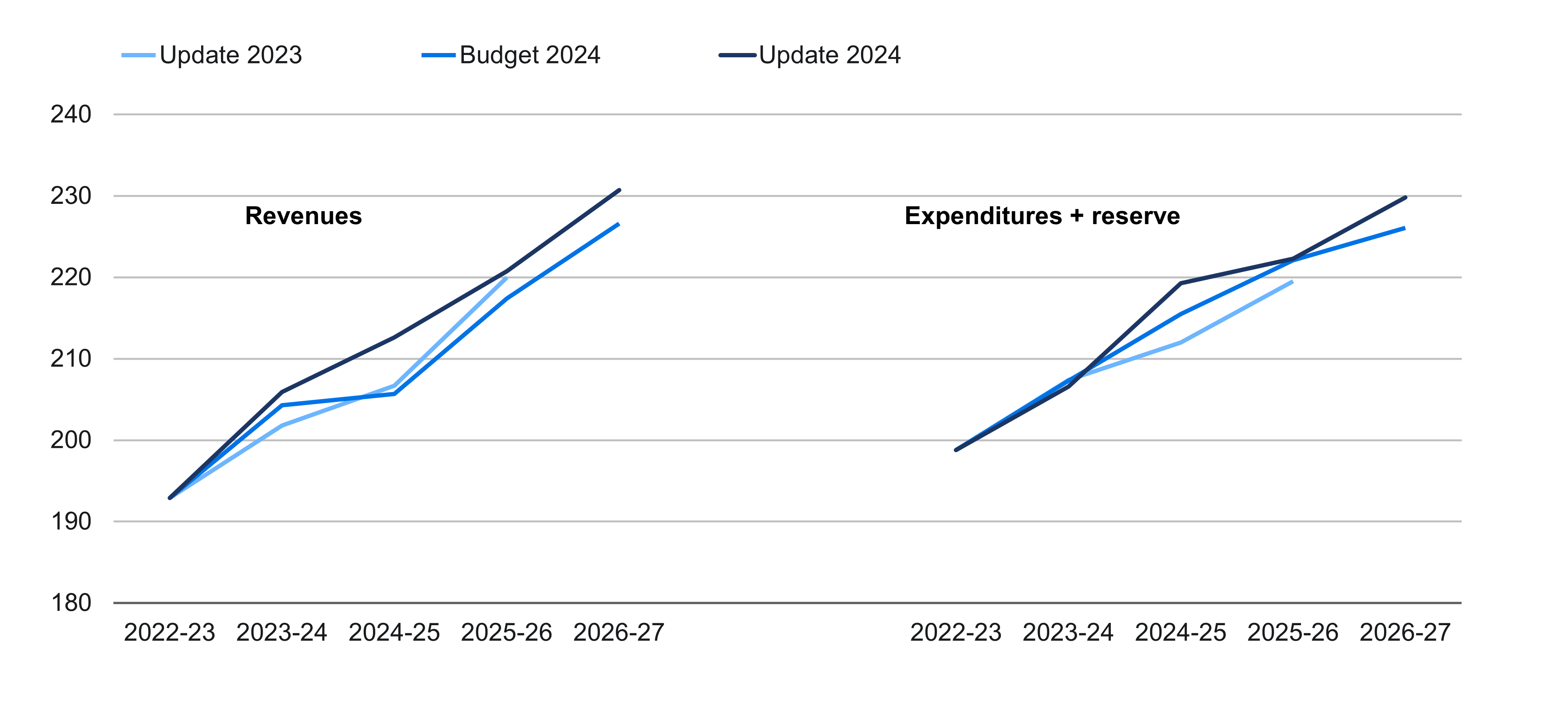
The Ontario government’s Fall Economic and Fiscal Outlook (FES) unveiled better-than-anticipated finances for the province relative to Budget 2024. Projected revenues have grown more than expenditures, bringing the province closer to fiscal balance. (See Chart 1).
Higher revenues will help to push down the deficit in 2024–25 and permit lower deficits next year on the path towards a budget surplus by fiscal year 2026–27. Additionally, the province’s interest costs have shrunk by $1.2 billion since the budget and the net debt-to-GDP ratio is reduced because of the shrunken deficit.
Having accrued higher-than-anticipated personal, corporate and sales tax revenues to the tune of an additional $6.9 billion, the government is wasting no time in leveraging the increased fiscal headroom by sending a cheque to all taxpayers at a total cost of $3 billion with a potential 2025 election in mind. A further $2 billion in new spending measures were announced bringing the total additional expenditure to $5 billion.
Chart 1
Ontario revenues rise more than expenditures this fiscal year
($ billions)
Sources: Signal49 Research; Ontario Ministry of Finance.
Economy turning the corner
The provincial government expects real GDP growth to slow in 2024, though their outlook is stronger compared to the spring budget. The revision reflects front-loaded economic strength this year underpinned by growth in non-residential investment and government spending. The updated forecast aligns closely with our own 2024 forecast of 1.0 per cent growth this year, placing Ontario’s real GDP growth rate slightly below our national forecast of 1.1 per cent growth. Between 2025 and 2027, the government projects an average of 2.1 per cent real GDP growth, a touch slower than our own 2.2 per cent forecast over this period.
As interest rates fall, Ontario’s economy is transitioning to a more expansionary footing. This process will be gradual, with cautious consumers and businesses taking time to adjust. The uncertainty around the timing of future rate cuts, a softer labour market and the prospect of mortgage renewals are all incentives to save, not spend. Nevertheless, a gradual fall in borrowing costs in Canada and the U.S. will help to re-energize demand for the province’s manufactured goods, notably auto shipments.
Ontario’s labour market weakened this year as hiring in the private sector took a breather. As of July, the number of job vacancies in the province was down by over 25 per cent on the same month one year prior. Job growth has been outpaced by labour force growth, resulting in an upward movement in the unemployment rate. We expect the jobless rate to peak at 7.2 per cent by the end of the year. In 2025 and 2026, the unemployment rate will reverse course, charting a downward path as labour demand picks up and lower levels of international migration take a sizeable bite out of labour force growth.
Our estimates for nominal GDP growth are mostly stronger than that of the government between 2024 and 2027. This is due to our more favorable outlook for corporate profits and implies that the government’s revenue outlook may be on the low side.
In summary, our economic view is largely in step with the latest government projections. All things considered; Canada’s largest provincial economy is holding up well under the weight of higher interest rates. Despite risks, the pace of growth is expected to rise in 2025 and 2026, offering a robust economic foundation, supporting the path towards fiscal balance.
The cheque is in the mail
The Fall Fiscal Update included a few new initiatives aimed at lowering costs for Ontarians. A hallmark announcement was the government’s plan to spend $3 billion for a one-time rebate early next year. All adults who filed taxes in 2023 will be eligible for a $200 rebate, and families will receive an additional $200 for each child under the age of 18. This initiative was implemented with a potential 2025 election in mind. With revenue projections stronger than forecast in Budget 2024, the government could have shortened their path to balance, but decided a cheque for all residents should take priority.
The rebate will benefit lower income households more than others, as these are families more likely to be financially constrained. However, we question whether providing the tax break to the highest income earners in Ontario was necessary, or if those funds could have been better spent elsewhere. High income households have significantly higher savings rates than middle- and low-income counterparts, meaning the rebate is likely to be stashed in savings accounts rather than recirculated through the economy.
A few bumps in the road ahead
Despite today’s rosier fiscal picture and our favourable outlook for the Ontario economy, we see several jarring risks to the government’s finances which have the potential to derail their path to balance.
Immigration cuts to trim the population further
The recent announcement by the federal government to slash immigration targets, combined with ambitions to significantly reduce the stock of temporary residents in Canada, will have important economic and fiscal implications. The recently unveiled 2025–2027 Immigration Levels Plan have not been incorporated into the FES. If the stated plans are fully implemented, a sharp slowdown in population growth can be expected, weighing on labour force and employment growth. Our preliminary estimates, which include the new immigration targets, suggest Ontario’s population growth would slow to 0.4 per cent in 2025 and 0.2 per cent in 2026. Much depends on the speed with which the stock of temporary residents falls.
Such a sharp deceleration in population growth would constrain employment and ultimately hurt demand in the economy. From a fiscal standpoint, this would weaken tax revenues. On the upside, the measures would reduce household formations, helping to restore balance in the housing market and quell still-elevated shelter price growth.
ZEV Investments: risky business
The provincial government is investing billions of dollars in the ZEV supply chain by subsidizing the construction of major manufacturing facilities in southern Ontario. The investments are bold and could pay off by creating thousands of jobs in the province, but they come with significant risks.
The infrastructure needed to meet the federal government’s target of 100 per cent ZEV sales by 2035 is still far from becoming reality. Meanwhile, some automakers have recently scaled back their ZEV production plans, increasing concerns about the market’s development. Adding that U.S. trade policy is uncertain, the list of downside risks is long, and one that cannot be ignored in the government’s fiscal outlook.
Another brick in the wall
The provincial government has the ambitious goal of building 1.5 million homes between 2022 and 2031. To their credit, Budget 2024 included $1.6 billion in new spending over the next three years on housing and public infrastructure, which adds to a growing list of previously announced provincial and federal measures.
These policies are a welcome change to past mistakes made by governments which focused on demand-side measures. Still, we see the number of units being built by 2031 falling more than 500,000 short of the government’s target under current policy levels. The newly announced reduction in immigration targets may ultimately lower the government’s target, but it will also reduce Ontario’s capacity to build homes.
All told, more is required from the government to fix the province’s housing crisis. The solutions won’t be cheap, likely requiring further tax breaks or other financial incentives for builders.
Making hay
In summary, the Ontario government’s FES painted a brighter picture than the province was showing last spring, with revenues forecast to be $6.9 billion higher and the economy outperforming expectations. The government’s response was election-focused, with tax rebates taking priority over accelerating the timeline to balance the budget. Despite an improved outlook for Ontario’s finances, the release underlines the inherent volatility of public finances. And considering all the risks in today’s landscape, there are still plenty of challenges before the province can achieve fiscal balance.
Related Insights
-

Exports See Largest Decline since April 2025
Canada’s merchandise exports declined 4.7 per cent (month-over-month) in January. Meanwhile, imports were down 1.1 per cent. As a result,…
-
Fourth Quarter Contraction Underscores a Weak Year
Real gross domestic product (GDP) increased 0.2 per cent in December. For the fourth quarter as a whole, real GDP…
-
Rising Unwrought Gold Exports Behind the Trade Balance Improvement
Canada’s merchandise exports increased 2.6 per cent (month-over-month) in December 2025. Meanwhile, imports were up 0.6 per cent. As a…
Comments