


The True Cost of Trump Tariffs: City Impacts
In February, we released results of our national and provincial scenarios that assessed the impact of 25 per cent tariffs on all Canadian exports to the U.S., with retaliation from Canada. Here we estimate the impact on the economies of 24 Census Metropolitan Areas (CMAs) of those same assumptions. The assumptions used to assess impacts at the CMA level are in-line with the assumptions used to produce our national and provincial scenarios, namely:
- U.S. tariffs of 25 per cent on all non-energy exports, and 10 per cent on all energy exports remain in place for one quarter.
- Canada’s response includes phase 2 retaliatory tariffs as outlined by the federal government earlier this month. We use the tariff list provided for the first $30 billion worth of goods (phase one tariffs), then use other noted products and our best estimates for the rest of the $155 billion (phase 2 tariffs).
- The U.S. does not further escalate because of Canada’s response.
- The U.S. also imposes tariffs of 25 per cent on Mexico and 10 per cent on China, with those countries each retaliating.
- Canada’s fiscal response is limited to the estimated tariff revenue, with 40 per cent of the tariff revenue going to households and 60 per cent to businesses.
- The tariffs are in place for 3 months, assumed to be the entirety of the second quarter.
- There is no response from the Bank of Canada to the tariffs.
National and provincial impacts
The national impacts show that real GDP would be down 1.3 per cent in the second quarter, when the shock is implemented, behind weaker consumption and lower exports. Meanwhile inflation would rise by 0.7 points above the baseline. By industry, the impacts are driven by a 57.4 per cent decline in motor vehicles and parts exports, which lead to a 5.2 per cent decline in manufacturing. Other industries that saw large impacts were wholesale trade (–3.6 per cent) and transportation and warehousing (–1.9 per cent).
Meanwhile, provincial impacts, built off the same scenario, were driven by how exposed exports were to the United States, what industries are key to the province, and how important goods exports were more broadly to the region’s economy. Impacts varied by province, with all being negatively impacted. The range of declines varied from 1.4 per cent in Alberta, Newfoundland and Labrador, Saskatchewan and P.E.I, to 0.7 per cent in Nova Scotia.
Impacts by city
As with the provinces, impacts by CMA depend on more than just how exposed exports are to the U.S. Each city has a unique economic structure. While the services sector makes up the majority of output in each CMA, cities that have a larger industrial base will be more impacted by tariffs, as the manufacturing sector is the most exposed to tariffs. Meanwhile, CMAs that are capitals tend to have a larger public sector, and therefore, are more sheltered from the impacts. We find cities that have more diversified economies, particularly those with a focus on business services, have impacts that fall in between. In all, real GDP impacts by CMA in the second quarter of 2025 range from a 0.8 per cent decrease from the baseline in St. John’s and Halifax to a 2.3 per cent decline in Guelph.
Chart 1
Impacts by city
(per cent change versus baseline, second quarter of 2025)
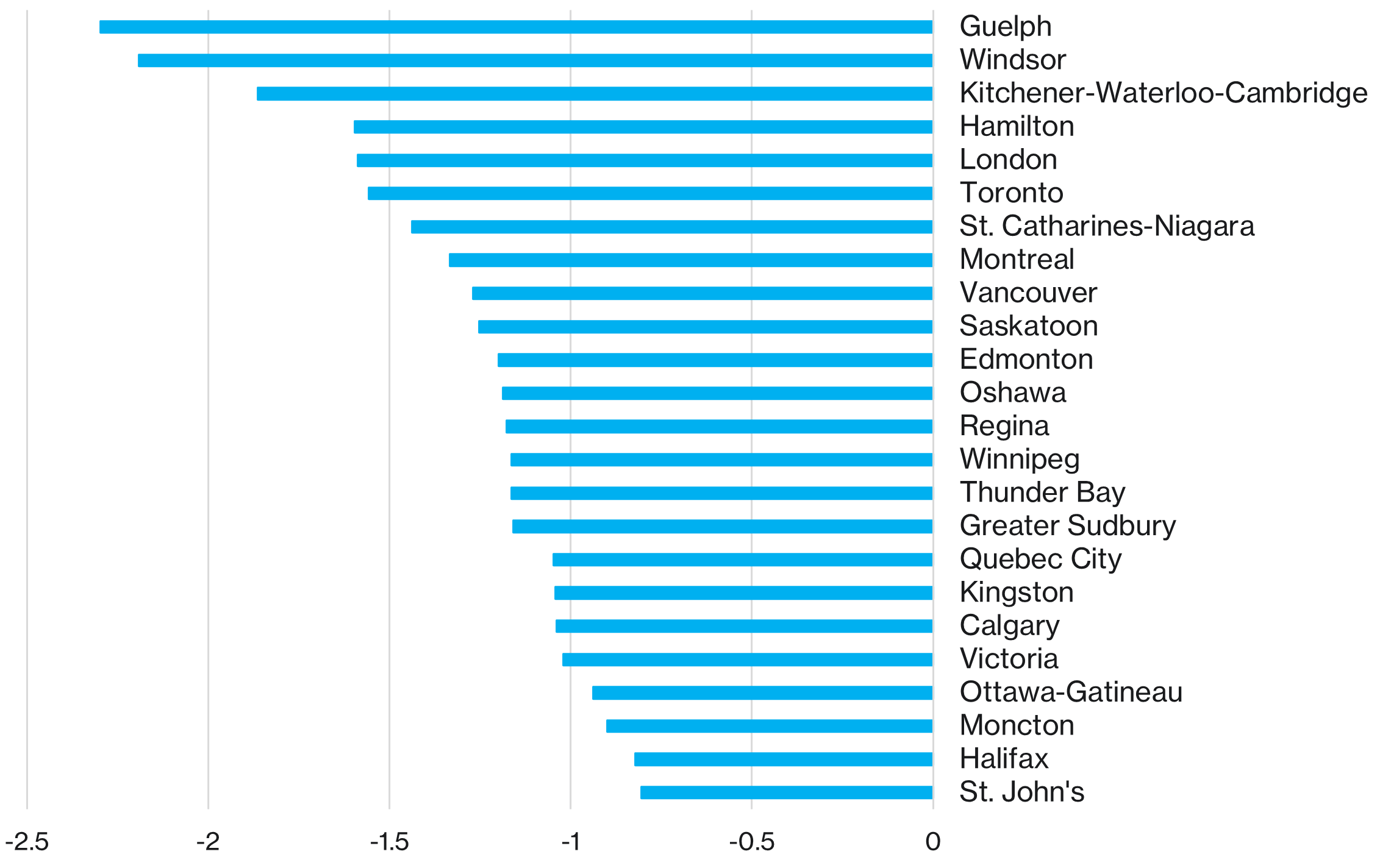
Sources: Signal49 Research, Statistics Canada.
Atlantic CMAs fare better than most
St. John’s
St. John’s economy is driven by services, sheltering the city from the worst impacts of tariffs. The region’s goods-producing sectors are more directly exposed to additional tariffs and so industries that stand to be hit the hardest include manufacturing, construction, and wholesale and retail trade. St. John’s construction sector was already forecast to contract this year in our baseline outlook, with declines anticipated in both output and employment. Import tariffs will only deepen the sector’s downturn. The tariffs scenario would lower real GDP in St. John’s by an additional 0.8 per cent from the baseline in the second quarter of 2025, resulting in a downgrade to annual growth of 0.3 percentage points.
Halifax
Due to its favourable industry mix, Halifax would see lower impacts from tariffs than most other CMAs. At the provincial level, Nova Scotia has limited dependence on international goods exports. Indeed, the province’s GDP is made up by 81 per cent services, and international goods exports account for only 11 per cent of GDP, the smallest share of any province. Halifax has a similar mix. Nonetheless, if 25 per cent tariffs on goods were placed on Canada for the second quarter, Halifax would still be impacted. Second quarter GDP would decline by 0.8 per cent below baseline, bringing annual GDP growth down 0.3 percentage points. In addition, employment would be 1.0 per cent lower than the baseline in the second quarter.
Moncton
Moncton’s economy is primarily service-oriented, with significant contributions from retail trade, healthcare and social services, public administration, and transportation and warehousing. However, its manufacturing sector, particularly aerospace and wood products, is vulnerable to U.S. tariffs, which could disrupt supply chains and raise production costs. Furthermore, the food processing sector, which is heavily reliant on exports, will be challenged by Chinese tariffs, which aren’t included in this scenario. As a result, Moncton’s real GDP is expected to be 0.9 per cent lower than our baseline forecast in the second quarter. Annual economic growth will slow by 0.3 percentage points below our current forecast.
Montreal Hardest Hit of Quebec CMAs
Quebec City
Quebec City’s economy, while somewhat insulated by its large services and public administration sectors, will still face challenges from tariffs. The CMA’s manufacturing sector, especially wood products, metal and machinery manufacturing are most vulnerable to American tariffs. We anticipate that real GDP in Quebec City will decline by 1.0 per cent relative to the baseline in the second quarter of 2025. This slowdown is expected to result in overall growth for 2025 falling by 0.3 percentage points compared to our baseline projections.
Montreal
Montreal’s economy is diversified with the goods-producing sector making up only 17 per cent of total employment. However, tariffs on certain sectors like aerospace, automotive, steel and aluminium, threaten to disrupt the city’s manufacturing sector. Real GDP is expected to decline by 1.3 per cent compared to the baseline for the same period, reflecting the broader economic impact of trade disruptions. On an annual basis, we estimate Montreal’s economic growth to fall by 0.4 percentage points in 2025 compared to our baseline.
Ontario CMAs with strong manufacturing bases are most exposed
Kingston
Kingston will see a smaller decline in its economy as a result of tariffs than many other Ontario CMAs. A high percentage of the city’s employment and output are from services-producing sectors, shielding its economy from the worst of tariffs. Kingston’s biggest industries by employment are healthcare and social assistance, and education which collectively account for about a quarter of total jobs. Comparatively, its manufacturing industry, which faces greater exposure to tariffs, only accounts for 6 per cent of the economy. Assuming tariffs cover a three-month period, Kingston’s real GDP is expected to come in 1.0 per cent lower in the second quarter of 2025, leading annual growth to be 0.3 per cent lower.
Oshawa
Oshawa is largely a service-based economy, with 76 per cent of its economic output coming from the service sector. Traditionally know for its auto sector, manufacturing is still a staple in the city and will feel the effects of tariffs more acutely than most other industries. Overall, this exposure to manufacturing will weigh on the city’s economy, amounting to a 1.2 per cent decline in GDP in the second quarter compared to the baseline. In annual terms, that translates to a 0.4 per cent decline in annual GDP.
Ottawa–Gatineau
Over forty per cent of all jobs in Ottawa–Gatineau are in either public administration, health, or education, which will be mostly sheltered from tariffs. Further, the city has a strong presence in commercial services, such as professional services and finance, insurance, and real estate. These industries will not be entirely immune to the trade dispute, but the negative impact will be significantly less than that on the goods sectors, particularly manufacturing. That will keep household incomes in good shape, mitigating the impact on consumer facing sectors such as housing and retail. Overall, widespread tariffs for a three-month period would lower real GDP in Ottawa-Gatineau by a relatively modest 0.9 per cent in the second quarter of 2025, with annual growth downgraded by 0.3 percentage points.
Toronto
Toronto’s economy is deeply rooted in service-producing industries, with the goods-producing sectors accounting for only 16 per cent of the city’s economic output. Although Toronto’s exposure to U.S. tariffs is less than some other cities in Canada, the trade conflict would still weigh heavily on Ontario’s capital. The magnitude of the U.S. tariffs and Canada’s retaliation to them will lead to lower global and domestic demand, higher inflation, and widespread output and employment declines for all the city’s industries. Hence, compared to our baseline forecast, real GDP in Toronto would be lowered by 1.6 per cent compared in the second quarter of 2025, and 2025 growth would be shaved by 0.4 percentage points.
Hamilton
While Hamilton has been trying to shed its “Steel City” image, steel and aluminum production and manufacturing remain vital sectors to the city. This steel is exported as a raw input and used in auto production, construction and other manufacturing. Tariffs on goods including steel and aluminum during the second quarter of 2025 would severely impact Hamilton’s economy. Real output in the second quarter would decline by 1.6 per cent off baseline figures, dragging down overall growth by 0.4 percentage points for 2025.
St. Catharines–Niagara
The St. Catharines–Niagara region would experience above average impacts as a result of U.S. tariffs. The region borders the U.S. and relies on cross border flows. Not surprisingly, tariffs would impact the manufacturing sector more than any other industry, but tariffs could weigh heavily on any industry that depends on the cross-border flows of people or goods. Overall, real GDP would be 1.4 per cent lower in the second quarter than in our baseline estimates, pulling annual output down 0.4 per cent.
Guelph
Guelph is highly exposed to any tariffs by the United States given the importance of the manufacturing and agriculture sectors to the region’s economy. In 2024, manufacturing’s share of employment was nearly 19 per cent, second only to Windsor in the cities covered in our outlook. More than half of the manufacturing jobs were in food, beverage and tobacco products and in transportation equipment. Our analysis shows that Guelph’s second-quarter real GDP would be 2.3 per cent lower than our baseline, reducing overall growth for this year by 0.6 percentage points. This is the largest impact among all the CMAs.
Kitchener–Waterloo–Cambridge
A large manufacturing sector, normally a strength, places Kitchener–Waterloo–Cambridge among Canada’s most tariff-exposed areas. The region’s significant footprint in the high-profile auto sector is a particular worry. Not all local manufacturing output is exported, though, with big firms like BWXT Canada producing for the domestic market. Still, we expect second quarter manufacturing to be 6.1 per cent lower than our baseline forecast. The area has been economically resilient and technologically innovative over the past century, positive attributes in times like these. Still, a three-month tariff imposition trims real GDP by 1.9 per cent from our baseline in the second quarter and by 0.5 per cent annually.
London
London’s economy, while somewhat insulated by its large service sectors, particularly healthcare and social services, and education, will still face significant challenges from the ongoing trade disruptions between Canada and the United States. While the service sectors make up around 77 per cent of the city’s economy, all sectors will be impacted to varying degrees. The manufacturing sector will be hit particularly hard in the second quarter of this year, though we still see work on Volkswagen’s $16 billion battery plant in St. Thomas forging ahead as planned. Overall, compared to the baseline, a three-month tariff trims our expectations of real GDP by 1.6 per cent in the second quarter and 0.5 per cent for 2025.
Windsor
Windsor is known as the automotive capital of Canada. With the city’s manufacturing sector making up around 25 per cent of GDP, blanket tariffs imposed by the United States will undoubtedly have a major impact on the local economy. In fact, out of all cities in our Major City Insights, Windsor would be second most impacted, after Guelph, but impacts could be greater if there are also restrictions on the amount of people moving across the border. The tariffs would trim our GDP forecast by 2.2 per cent in the second quarter compared to the baseline. On an annual basis this impact is 0.6 per cent.
Greater Sudbury
A roughly 29 per cent drop in nickel’s price between 2022 and 2024 is probably a bigger worry for Sudbury than the effect of U.S. tariffs on its relatively small manufacturing sector. Surging Indonesian production, tepid markets for nickel-consuming electric vehicles and new battery technology that uses less nickel are responsible. Sudbury is a regional centre for government service provision; associated output and employment is tariff-immune, providing local protection. Tariffs lasting one quarter would lower our second quarter projections by 1.2 per cent, while the annual decline compared to the baseline would be 0.4 per cent.
Thunder Bay
Thunder Bay’s position as a regional centre for government and health care services gives it a large public sector presence. This will help protect it from the worst effects of the U.S. tariffs. Ongoing construction of a very expensive jail provides additional shelter. The city’s manufacturing sector is small by national standards and is centred on Alstom, a domestically focused rail car producer, and forest-products production. The latter already has long experience with U.S. tariffs. Compared to our baseline 2025 forecast, a three-month tariffs regime would trim our second quarter expectations of real GDP 1.2 per cent below the baseline forecast and by 0.4 percentage points for the year.
Oil focused regions of Prairies will be hit
Winnipeg
Winnipeg’s total real GDP is made up of 19.8 per cent goods-producing industries, which are more exposed to tariff measures than services. Indeed, the city’s construction and agriculture industries will face a setback from less trade and higher input costs. Tariffs will also strain the city’s transportation and warehousing sector as they would soften the value proposition of the city’s ongoing development of the Centreport Rail Park—a development that highlights its accessibility to the North American market as a selling point for investment. Compared to our baseline forecast, a three-month tariff would lower expected GDP by 1.2 per cent in the second quarter and by 0.4 per cent on an annual basis.
Regina
Over 75 per cent of Regina’s economy is in services-producing industries. Being the provincial capital, the city has a healthy share of public administration workers (9 per cent in 2024). The city also has large healthcare and social services, and educational services sectors. The importance of the services sector protects the city’s economy from some of the tariffs’ effects. However, other important industries to the Regina economy, including agriculture, and mining, quarrying, and oil and gas extraction, will be impacted. In our scenario, Regina’s real GDP is expected to be 1.2 per cent lower our baseline for the second quarter of 2025, and 0.4 per cent lower than our annual estimate.
Saskatoon
Although Saskatoon’s economic diversity provides some insulation from tariff impacts, a substantial 36 per cent of its economic activity remains reliant on goods-producing industries, which are more vulnerable. The agriculture, mining, and construction sectors will face challenges from reduced trade, increased input costs, and weaker global demand for resources. Additionally, the tariffs will hit the city’s manufacturing sectors particularly hard. On the services side, wholesale trade will feel the brunt. Overall, real GDP by is expected to fall 1.2 per cent below baseline for the second quarter and 0.4 per cent for 2025.
Calgary
Calgary remains an oil city. The primary and utilities sector generated about a fifth of its total output in 2024, double the national average. This benefits the city, since Canada’s energy exports face only a 10 per cent U.S. tariff. However, the oil industry will still have spillover impacts, through reduced investment in the industry and the impact of weaker U.S. demand for oil on its economy. The domestically focused finance, insurance and real estate sector is the city’s largest, and provides some insulation. All told, tariffs lasting for one quarter would lower real GDP in Calgary by an additional 1.0 per cent in the second quarter of 2025. For all of 2025, the tariffs would trim output growth by 0.3 percentage points.
Edmonton
Although Edmonton’s economy is tied to the oil and gas sector, the city is Alberta’s capital, meaning its relatively large public sector will help to shield it from U.S. tariffs. Finance, insurance and real estate is the city’s largest industry and caters to Canadians, so is relatively safe from tariffs. We think a three-month tariff regime would result in Edmonton’s real GDP being 1.2 per cent smaller in the second quarter of 2025 compared to our baseline outlook. Annually, the tariffs would cut 2025 output growth by 0.4 percentage points.
Services and government provide some shelter from tariffs in British Columbia CMAs
Vancouver
Vancouver’s service-based economy will offer some protection from the trade conflict with the U.S. Almost 40 per cent of the city’s output is driven by the finance, insurance and real estate, and professional, scientific and technical services sectors. Further, the manufacturing sector—which is highly exposed to tariffs—accounts for just 6 per cent of the city’s economic activity. Altogether, tariffs for a three month period would lower real GDP in Vancouver by 1.3 per cent in the second quarter of 2025 compared to the baseline. On an annual basis, both output and employment growth would be 0.4 percentage points lower this year because of the tariffs.
Victoria
As a government city, a significant portion of Victoria’s economy is centred around public services, such as public administration, healthcare and social services, and educational services. These three sectors made up 33 per cent of total output in 2024. As a result, the city is relatively insulated to the effects of tariffs in comparison to many other cities. With that said, tariffs will still hurt Victoria’s economic outlook. The industries that will be hardest hit are ones that rely on trade with the United States—manufacturing, construction, wholesale trade, transportation and warehousing, and other services. We estimate that Victoria’s real GDP will fall 1.0 per cent more than in the baseline forecast for the second quarter. For 2025 overall, real GDP will be 0.3 per cent lower than the baseline.
As the Canada–U.S. relationship is being reset, we’re examining what Canada must do to thrive in this changing world. Get the latest research.
Related Insights
-

Canada’s Labour Market on the Back Foot
Employment declined by 84,000 in January (–0.4 per cent). The unemployment rate rose to 6.7 per cent, an increase of 0.2 percentage points,…
-

Exports See Largest Decline since April 2025
Canada’s merchandise exports declined 4.7 per cent (month-over-month) in January. Meanwhile, imports were down 1.1 per cent. As a result,…
-

Fourth Quarter Contraction Underscores a Weak Year
Real gross domestic product (GDP) increased 0.2 per cent in December. For the fourth quarter as a whole, real GDP…
Comments