

Revolutionary Building for the North
It takes little imagination to understand the potential uses of 3D printing in the Canadian North. Housing and general construction is one of the greatest challenges across the territories and the upper, remote regions of the provinces. It costs a great deal of money, working within a short transportation season, to move construction supplies into the North and to complete construction efficiently. There is a severe shortage of suitable housing and appropriate buildings across the North,1 and the high cost of standard building systems has prevented governments from coming close to meeting the urgent construction, maintenance, and repair needs of northern communities.2 Building suitable 3D housing, for one-third the cost or less, could unleash a revolution in northern home construction, but only if the technology works in Arctic and sub-Arctic settings, that is, if people are willing to live in the homes; if the actual final costs are truly competitive; and if the technology can remove, avoid, or mitigate some of the many challenges that confront construction in the North.
The potential benefits of 3D-printed buildings in the Canadian North must be considered. These benefits include decreases in costs, a reduction of housing shortages, reduced transportation challenges, and increased local and individual input into the design of northern homes. However, several potential challenges exist, including impacts on existing construction firms, suitability for northern climates and conditions, loss of standard construction jobs, the need for people with advanced skills, and disagreements over design.
3D Printing Construction
The concept of 3D printing, or additive manufacturing, has been around for quite some time. The main idea is simple: selected materials, ranging from nylon to recycled wood, ceramic, thermoplastic, steel, and resin, are extruded (forced out) in layers from a machine, creating a new product. The output can be a standardized item—the specifications for a growing number of products can be downloaded from the Internet and loaded directly into the 3D printer. Users can also design their own products, typically on a computer, and then send the specifications to the printer. More than 15 years ago, architects experimented with 3D printers that worked with paper to produce exact scale models of housing and other building designs.3
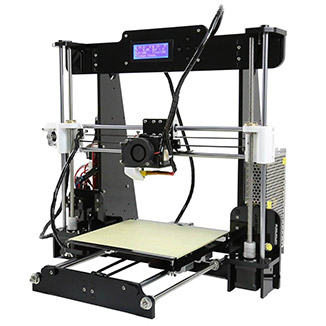
The Anet A8 3D printer targets budget-conscious consumers.
Source: 3D Printing Canada.
Small, consumer-oriented 3D printers, which cost tens of thousands of dollars a few years ago, can be purchased now for a few hundred dollars. larger, commercial 3D printers, particularly those that can extrude metal or other industrial materials, will set the purchaser back US$120,000 or more.4 3D printers have been used to produce automobile and machine parts and domestic devices like door knobs. There has been genuine excitement about the use of 3D printers to produce human organs and even skin—one of the more startling developments in recent years.5 Promoters have talked about printing high-quality musical instruments and specialized mechanical devices.6 New applications have emerged, like printed parts for jet engines.7 But many of the products seem trivial, if not gimmicky. 3D printers could be used with melted chocolate to print candy.8 Using a machine to print candy is a handy party trick, but it is far from a useful commercial application of high economic and community value. 3D printers clearly have some practical value, but it is still unclear precisely what the real benefits will be.
As part of a new research series on emerging technologies, this report looks at how 3D-printed homes could be used to address housing issues in Canada’s Northern and Indigenous communities. The Cool Ideas series aims to spark discussion about how emerging technologies could potentially improve or disrupt the quality of life in Canada’s North.
The concept of 3D printing, or additive manufacturing, has been around since the 1980s. The main idea is simple: selected materials, ranging from nylon to recycled wood, ceramic, thermoplastic, steel, and resin, are extruded (forced out) in layers from a machine, creating a new product. In the construction sector, new possibilities have begun to emerge in relation to large-scale 3D-printed projects. These large-scale projects use extruded concrete—a long-time construction staple—and promise impressive savings in time, labour costs, and overall product expenses.
Building suitable 3D housing could unleash a revolution in northern home construction, but only if the technology works in Arctic and sub-Arctic settings.
It is vital that the North explore these technological opportunities on its own and not simply wait for southern communities, companies, and governments to undertake the research and experimental work—not all of which will be directly relevant to northern circumstances—and make decisions on its behalf. Consequently, the following is recommended:
- Develop an enabling policy environment.
- Determine whether 3D printing is a viable option for the North.
- Ensure research is driven by Northerners, for Northerners, in a northern context.
- Identify and prepare for negative outcomes as well as new opportunities.
- Don’t give up on innovation!
This is the first of approximately 10 reports within the Cool Ideas series to be published over the next several years. Potential topics for future reports include remote surgery, tech-driven education, and autonomous trucks, among others.
The New Technology and Construction
Story after story has appeared about the application of 3D printing in the construction sector. People are increasingly focused on the idea that 3D printing can be a desktop or shop-floor technology, with thousands of potential applications for the construction industry. And new possibilities for construction have also begun to emerge in relation to large-scale 3D-printed projects. These large-scale projects use extruded concrete—a long-time construction staple—and promise impressive savings in time, labour costs, and overall product expenses.
Dubai and the United Arab Emirates, on a long run of oil wealth, are experimenting with office and apartment construction, taking designs that previously took weeks to complete with the objective of producing them in a few days at a fraction of the cost of the former construction approach.9 Meanwhile, China has been quick into the field, launching home construction ventures and even high-rise buildings.10 In countries like France, the emphasis has been on energy-efficient residential applications.11
What a few years ago looked like an industry gimmick is now worth taking seriously.
Other construction firms have developed solutions that allow them to build bridges (primarily for pedestrians and bicycles), homes, recreational properties, and other buildings.12
The construction printers work by erecting large printing frames with long-armed robots or printing heads attached to movable tracks that distribute the materials as designed and intended. The work is typically done in concrete, although new materials could well be introduced in the coming years.
What a few years ago looked like an industry gimmick is now worth taking seriously, or at least considering carefully. China is building whole suburbs using 3D printing techniques, producing 10 small homes in a single day.13 Developing nations are looking to use 3D-printed homes to meet the considerable housing needs of the urban poor.14
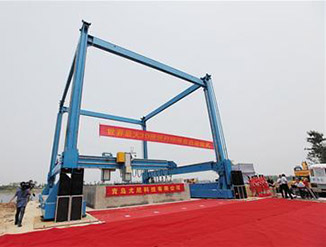
Qingdao Unique Products Develop Co.’s 3D printer will print a replica of Beijing’s “Temple of Heaven” in approximately six months.
Source: Desmond, “Chinese Create Huge 40×40 Foot Graphene/Fiberglass 3D Printer.”
Russian and Ukrainian companies have developed inexpensive house construction systems—promising to build 400-square-foot homes in under 24 hours and at a cost of around $10,000 each.15 The homes and buildings are more than simple cinder-block construction. The intricate machines allow for the precise inclusion of door and window openings as well as appropriate access for electrical and plumbing systems, which ensures that the finishing work can be completed expeditiously. Work to date has shown that 3D-printed homes can be solid, viable, inexpensive, and quickly built. Some companies say that they are working on systems that integrate the use of concrete, plastic, and metal, conceptually permitting the construction of an entire building in a single process.16
Scientists are also working on adapting the 3D printing process to use local materials.17 In this sense, building in the North could be within the technological capabilities of the new systems, systems that may offer a way of addressing some of the long-standing housing quality and supply problems that have plagued the country’s northern and remote regions. Some of the strategies seem right out of the pages of a sci-fi novel. The American research group DARPA (Defense Advanced Research Projects Agency), the source of many innovations over the years, is working on the concept of a living building made from organisms that could transform the very nature of construction.18 There may be major gaps, however, between frontier science and practical applications in Nunavut.
The structure of this 400-square- foot home was constructed in less than 24 hours, using a mobile 3D printer.
The Potential Downside
All technologies have a wide range of consequences, some anticipated and some that show up unexpectedly. While the benefits of social media are quite evident, the rise of bullying, the impact on teenage self-esteem, and the negative impacts on education were not anticipated. It is much the same with 3D printing. like all new technologies, there will be costs and challenges associated with the introduction of these systems, particularly within the context of the Canadian North. Key challenges and considerations include the following:
- It is not yet known whether 3D-printed homes can handle Arctic climates, in terms of either home heating (and related energy costs) or the deterioration of building materials in extreme cold conditions. 3D printers can use combinations of extruded concrete and foam, which could address some of the insulation issues, as could specially designed materials with high insulation values. But how plausible this is and whether it will work in the North is not yet clear.
- There is insufficient evidence at this time to determine whether 3D-constructed homes will avoid the problems of condensation and mold that have been challenges for standard wood frame construction.27
- 3D-printed buildings would, of course, be subject to permafrost as well as the shifting ground associated with permafrost degradation due to climate change across the North. It is unclear whether 3D-constructed homes would be more or less effective than other forms of construction in this environment. Existing and new technologies (such as thermosyphon stabilized foundations, space frames, screw-jacks, and other techniques) could potentially be applied to 3D-constructed homes (as with other types of builds).28
- Existing construction companies would have to either adapt to the new system or face intense competition from emerging 3D printing firms. It is possible that many of these companies would be replaced by southern-based, short-term, fly-in fly-out 3D builders.
If 3D printing systems prove effective in northern contexts, construction and transportation workers would lose work, with a subsequent rise in unemployment.
- Construction is a vital, if seasonal, source of employment in the Arctic. A full 3,400 workers of the 22,000 employed yukoners worked in construction-related trades, including in transportation, and as equipment operators in 2017.29 If 3D printing systems prove effective in northern contexts, construction and transportation workers would lose work, with a subsequent rise in unemployment and the social challenges associated with unemployment. Some new 3D printing jobs would be created, but not very many. The summer construction season employs many outsiders, creates customers for hotels and restaurants, and supports a network of supply and service firms. Many of these direct jobs would be at risk.
- 3D printing would place a priority on individuals with advanced skills, particularly in design, robotics, and material science. It is likely that few of the displaced employees among the current workforce would be able to make the transition to employment in the new technology-rich workforce.
- The introduction of variation—in size, construction materials, design, and other elements—in building design could become a source of disagreement within communities. The uniformity of government housing has mitigated against this issue in most northern and remote communities; the introduction of personally designed homes could be a source of some tension.
Table 1 illustrates the potential benefits and challenges of 3D-printed construction in Northern Canada.
Table 1
Potential Benefits and Challenges of 3D-Printed Construction in Northern Canada
| Potential benefits | Potential challenges |
|---|---|
|
|
Sources: Report of the Standing Senate Committee on Aboriginal Peoples, We Can Do Better, 29–30; Yukon Bureau of Statistics, Yukon Employment Annual Review, 2017, 3; Signal49 Research.
On Balance
The country needs to determine if 3D-printed construction is suited to Northern Canada and if its use can contribute to cost reductions and improvements in the availability and durability of housing. The Canadian North should consider making preliminary, experimental investments in researching and testing 3D-printed building technologies. Challenges exist to be sure, including technological, environmental, social, and employment-related challenges. If the 3D system works, as it appears it might (though perhaps not to the level anticipated by its strongest proponents), the construction sector in the Canadian North will change dramatically.
The Canadian North should consider making preliminary, experimental investments in researching and testing 3D-printed building technologies.
The new building system is not a magic bullet. It will not work as well as some people think, but it will likely work better than critics suggest. One way or another, 3D printing is an excellent indication of the changes coming into operation. It is unclear whether transformation will occur in five years, 10 years, or even 20 years or more. In time, however, the construction industry will be reformed through technological innovation. There is a good chance that 3D printing is the beginning, not the end, of that process. Northerners should be proactive and not miss the opportunity to determine whether it holds promise as a technology for Canada’s North and to identify, prevent, and mitigate any potential pitfalls.
Priority Issues to Address and Next Steps
It takes big, bold steps to get to the future—but each leap forward has to be calculated, realistic, and carefully managed. This is true of 3D printing just as it is true of all significant emerging technologies. Jumping full force into the future is reckless: many billions of dollars have been squandered on ill-advised forays into the world of technological innovation. This said, it is vital that the North explore these technological opportunities on its own and not simply wait for southern communities, companies, and governments to undertake the research and experimental work—not all of which will be directly relevant to northern circumstances—and make decisions on their behalf. Consequently, the following steps are recommended:
Develop an Enabling Policy Environment
There is no debate as to the problems associated with the quality, availability, and adequacy of housing across northern and remote Canada. And there is little disagreement over the need for alternative solutions to address these problems. However, the policy environment must work toward enabling the investigation of, and investments in, new and innovative construction approaches—such as 3D printing. Public investments into whether the technology is a viable option (in some form or fashion) for addressing housing problems are needed. The public policy/public sector role isall the more relevant because market-based solutions are generally not realistic for northern housing. For isolated communities that have few amenities and services, small population bases, and no roadsconnecting them to the rest of the country, there is no housing economy. In these instances, publicly funded housing is the norm. Thus, key policy questions have to be resolved if we are to be able to determine whether 3D printing offers technological solutions to long-standing problems.
Determine Whether 3D Printing is a Viable Option for the North
Research—both theoretical and practical—is needed to determine whether 3D printing can resolve the many challenges, or even some of the challenges, that confront housing construction in northern and remote regions. These include the high cost of building, transportation bottlenecks, and short construction seasons. They also include the technical challenges that confront northern homes. For instance, how would 3D-printed homes compare with other houses in terms of their performance related to energy efficiency, permafrost and permafrost degradation, mold, durability, and maintenance? In addition, to what extent is the technology portable? Can it be licensed and taken on by communities? It goes without saying that 3D printing will need to demonstrate advantages over existing systems and technologies if it is to be a viable option for Canada’s North.
Substantial community input is needed to ensure that the limits and challenges of 3D printing are understood and that the concept is not oversold.
Ensure Research is Driven by Northerners, for Northerners, in a Northern Context
A northern consortium, potentially for the whole North or for a specific region or community, should be set up to launch and manage 3D research and investigation This consortium should include pilot projects that test the new technologies. likely partners include Indigenous economic development organizations, local governments, territorial or regional governments, 3D printing companies, and academic research centres. Substantial community input is needed to ensure that the limits and challenges of 3D printing are understood and that the concept is not oversold. In the rapidly changing world of emerging technologies, failure is a key part of the learning process. Tests should incorporate more than one firm’s technology and should be conducted in several different geographical areas. A subsidiary goal should be to have Northerners understand that they are participating in, and contributing to, a potentially transformative area of investigation for Northerners and others.
Identify and Prepare for Negative Outcomes as Well as New Opportunities
Should 3D printing prove a promising technology for housing construction in the North, it will be important to identify and prepare for negative consequences and disruptions. In particular, local, regional, and federal governments as well as Indigenous development corporations should determine how best to address important challenges such as the displacement of existing companies and investments; changes to employment and procurement structures; the spillover effects for associated sectors (such as the retail and hospitality industries); and economic leakage (with the potential for a greater flow of dollars out of the North to southern-based firms and employees). That said, efforts should also be made to ensure that any advantages that may arise as a result of adopting 3D printing are identified and maximized. There will be benefits beyond the homes and technology themselves. It will be important to be creative in thinking about what these opportunities may be.
Don’t Give Up On Innovation!
Should the value and viability of 3D printing technology be more limited than is hoped, we should not give up on the critical objective of identifying new and innovative ways to address the significant housing issues that confront the North. Other technologies could emerge—technologies that are all the more effective at improving the quality and quantity of the North’s housing stock. lessons learned in investigating 3D printing technology will be of use in further investigation. We must build on our successes and learn from our failures … and continue to be open to opportunities and aware of the challenges associated with new and emerging technologies.
Northern Applications
It takes little imagination to understand the potential uses of 3D printing in the Canadian North. Housing and general construction is one of the greatest challenges across the territories and the upper, remote regions of the provinces. It costs a great deal of money, working with a short transportation season, to move construction supplies into the North and to complete construction expeditiously. Remote communities hoping to build homes must schedule the transportation of supplies months in advance, since builders rely on ice roads or, for many Arctic communities, sealifts to bring in the materials. In Nunavut, it costs between $400,000 and $550,000 to construct a new public housing unit—three times the cost for the same unit in Canada’s southern urban areas.19 Similarly, for a fly-in community in Northern Ontario it can cost close to $350,000 to build a standard 1,200-square-foot wood frame house—a form of construction that is often poorly suited to the harsh climate and challenging local environment.20
There is a severe shortage of suitable housing and appropriate buildings across the North,21 and the high cost of standard building systems has prevented governments from coming close to meeting the urgent construction, maintenance, and repair needs of northern communities.22 Building suitable 3D housing, for one-third the cost or less, could unleash a revolution in northern home construction, but only if the technology works in Arctic and sub-Arctic settings, that is, if people are willing to live in the homes; if the actual final costs are truly competitive; and if the technology can remove, avoid, or mitigate some of the many challenges that confront construction in the North. (See “The Northern Context and 3D Printing Construction: An Uncertain Relationship.”)
The Northern Context and 3D Printing Construction: An Uncertain Relationship
Techno-enthusiasm is commonplace around innovation, technology, and new devices. But these passions must be balanced by a sense of reality and a sober assessment of the context in which the new technology is to be applied. This is especially true for the conditions and context that impact construction in Canada’s North. When considering 3D printing as an option for the region, it should be noted that there are major unanswered questions—especially in relation to the technical challenges and construction requirements in this unique environment. These include questions about the suitability of concrete as the main material for the shell (the building envelope) of homes. Concrete may not be ideal for ensuring heat efficiency in extreme cold or structural integrity under snow loads. And it may prove too heavy a material for houses that are built on permafrost-layered terrain. Other pivotal, unanswered questions are linked to the local and regional availability of suitable construction materials; the relative cost of the shell (produced by a 3D printer); and what the technology will mean for the finishing work and internal fittings (heating and venting systems, cabinets, electrical supplies, etc.) that are a significant component of the cost of home construction. Costs savings could prove illusory. It is possible, in fact, that the best use of 3D printers in the housing sector could be for the local printing of components rather than for the construction of entire homes. Certainly, it is probable that 3D construction will not prove a panacea, and that it will be more effective in some northern and remote locations than others and for certain (as opposed to all) purposes.
Source: Jeff Armstrong, CEO, Cold Climate Solutions.
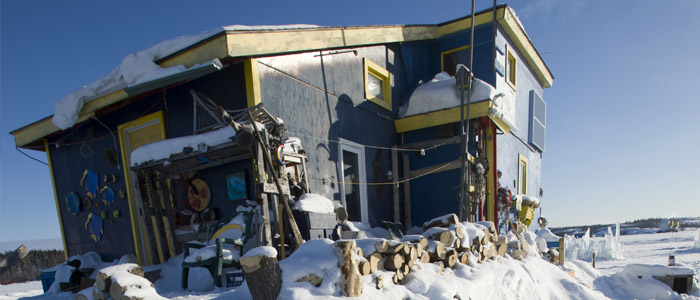
House in Old Town, Yellowknife.
Source: Getty Images.
If suitable materials can be found and other key northern construction challenges addressed, the general application of 3D printing for homes, public and commercial buildings, storage facilities, bridges, and other highway construction elements could make a meaningful impact in the North. The material issue is a serious one, however. There is little commercial-grade sand suitable for making concrete available in many northern, and especially high-Arctic, regions, which could be a significant barrier to using the 3D printing systems in some areas. And, as mentioned above, concrete may not be an ideal material for northern environments, particularly where permafrost degradation and ground subsidence are at play.
It is not a given that 3D printing systems will work well in the North.
It is not a given that 3D printing systems will work well in the North. The homes must be suitable for Arctic and sub-Arctic conditions; the shortcomings of the current housing stock in this regard contributes to the rapid deterioration of homes and severe backlogs in maintenance and repair.23 The problems with current approaches go well beyond the excessive housing costs and construction times. It is well documented across the North that the shortage of housing leads to overcrowded homes, which can in turn contribute to serious health problems, interfere with students’ learning and education, intensify domestic tensions, and otherwise add to the challenges of northern living.24 There are many questions about 3D-printed homes that remain unanswered. However, at this early stage there is also evidence that 3D printing allows for great flexibility in design, personal creativity in the development of built space, and a cost-effective and efficient construction model that could potentially help address many of the more serious construction challenges facing the region.
The Potential Upside for the North
3D-printed buildings could become a significant part of the construction future in the Canadian North. At present, this technology is being applied and investigated in a limited fashion. But the potential benefits must be considered:
- There could be a major reduction in the overall cost of construction in the North. Northern homes currently cost between $300,000 and $550,000 each to build;25 early indications are that 3D-printed homes could be substantially less.
- Using funds currently allocated for standard house construction, the transition to 3D-printed homes could contribute to a more rapid elimination of the shortage of housing in the North.
- Due to the use of locally available materials and a reduced reliance on the shipment of construction materials to isolated communities, the technologies could mean improvements to the transportation bottlenecks and long-distance shipping issues that add so much to the cost and inefficiency of construction in the North.
- The technologies could mean liberation from the tyranny of the short, intense construction season in the region. The construction process would be shorter, with more homes (at least the shells) being produced in a shorter time. Also, it is possible that continual improvement in the science of concrete and other materials, combined with the fact that the need for manual labour would be reduced, could mean that construction would no longer be confined to the summer.
The transition to 3D-printed homes could contribute to a more rapid elimination of the shortage
of housing in the North.
- 3D printing would allow for local, and even individual, input into the design of northern buildings, ending the cookie-cutter approach that currently dominates, largely for reasons of efficiency and cost control.26 One of the greatest challenges in northern housing relates to the cultural suitability of what are, in reality, southern and non-Indigenous building designs. 3D printers allow for greater flexibility than standard construction (curves are more readily incorporated, for example), which can be used in consultation with Indigenous peoples and community authorities to design homes and other buildings that reflect both local conditions and northern cultures and values.
- There is a great opportunity to build on Northerners’ artistic and creative abilities and capitalize on the potential of 3D printing products to create new economies, potentially separate from housing, in the North.
- Canadian firms and technology specialists could become world leaders in the development of 3D-printed solutions in the far north and other harsh climates, and could develop global markets for their products and services.
Source: Deamer, “This House Was 3D Printed in less Than 24 Hours.”
Appendix A: Bibliography
3Dnatives. “3D Printing: The Future of Construction.” January 31, 2018. Accessed July 19, 2018.
—. “The 11 Best 3D Printed House Companies: 3D Printing Entire Buildings.” February 12, 2018. Accessed July 19, 2018.
—. “Top 15 3D Printed Music Instruments & Music Applications.” June 21, 2017. Accessed July 19, 2018.
3D Printing Canada. “Anet A8 Review.” December 1, 2017.
Barbee, Brie. “These Awesome 3D-Printed Houses Give a Glimpse Into the Future of Construction.” Digital Trends, April 6, 2018.
Barrat, James. Our Final Invention: Artificial Intelligence and the End of the Human Era. New York: St. Martin’s Griffin, 2015.
Brynjolfsson, Erik, and Andrew McAfee. The Second Machine Age: Work, Progress and Prosperity in a Time of Brilliant Technologies. New York: W. W. Norton, 2013.
Canadian Radio-Television and Telecommunications Commission. Satellite Inquiry Report. Ottawa: Canadian Radio-Television and Telecommunications Commission, 2014.
Costrel, France, and Sam Rega. “The First 3D Printed House Is Coming, and the Construction Industry Will Never Be the Same.” Business Insider, March 22, 2015. Accessed July 19, 2018.
Council, Aaron, Michael Petch, and Edward Long. 3D Printing: The Rise of the Third Industrial Revolution. Amazon Digital Edition, 2014.
Deamer, Kacey. “This House Was 3D Printed in Less Than 24 Hours.” LiveScience, March 7, 2017.
Department of the Environment. A Homeowner’s Guide to Permafrost in Nunavut. Yellowknife: Government of Nunavut, 2013.
Desmond, Randall. “Chinese Create Huge 40×40 Foot Graphene/Fiberglass 3D Printer—Planning on Constructing Homes.” 3D Print.com, June 25, 2014.
Diamandis, Peter H., and Steven Kotler. Abundance: The Future Is Better Than You Think. New York: Free Press, 2012.
Diop, Makhtar. Africa Can Enjoy Leapfrog Development.” China Daily, October 11, 2017.
Dubai Future Foundation. “Dubai 3D Printing Strategy.” n.d. Accessed July 19, 2018.
Feldman, Nathan. “Is 3D Printing the Future of Infrastructure?” U.S. Chamber of Commerce Foundation, June 30, 2015. Accessed July 19, 2018.
Gallagher, James. “Doctors 3D-Print ‘Living’ Body Parts.” BBC News, February 16, 2016. Accessed July 19, 2018.
Garfield, Leanna. “A Robot Can Print This $64,000 House in as Few as 8 Hours—Take a Look Inside.” Business Insider, December 14, 2017. Accessed July 19, 2018.
Government of Canada, “Canada’s National Housing Strategy: A Place to Call Home.” Ottawa: Government of Canada, 2018.
Jacobsen, Annie. The Pentagon’s Brain: An Uncensored History of DARPA, America’s Top Secret Military Research Agency. New York: Back Bay Books, 2016.
Kaku, Michio. Physics of the Future: How Science Will Shape Human Destiny and Our Daily Lives by the Year 2100. New York: Anchor, 2012.
Larsen, Joan Nymand, and Gail Fondahl (eds.). Arctic Human Development Report: Regional Processes and Global Linkages. Copenhagen: Nordic Council of Ministers, 2014.
Magic Candy Factory. “Katjes Magic Candy Factory.” n.d. Accessed July 19, 2018.
Mathews, Lee. “Modular 3D Printer Builds Sustainable Houses Using Locally-Sourced Materials.” Geek.com, October 12, 2018. Accessed November 13, 2018.
Megri, Ahmed Cherif, Ismail Megri, Sameer Hamoush, and Taher M. Abu-Lebdeh. “Teaching a Methodology Towards a Sustainable, Affordable 3-D-Printed House: Heat Transfer and Thermal Stress Analysis.” Paper presented at 2018 ASEE Annual Conference and Exposition, Salt Lake City, June 24, 2018.
Molloy, Mark. “This Incredibly Cheap House Was 3D Printed in Just 24 Hours.” The Telegraph, March 3, 2017. Accessed July 19, 2018.
Nunavut Housing Corporation. Nunavut Housing Corporation’s Appearance Before the Standing Senate Committee on Aboriginal Peoples: Nunavut Is Facing a Severe Housing Crisis. March 23, 2016. Accessed July 19, 2018.
O’Neal, Bridget Butler. “DARPA Researchers Bioengineering a New Class of Construction Materials: Will Homes Soon Repair Themselves?” 3Dprint.com, August 12, 2016. Accessed July 19, 2018.
Pinker, Steven. Enlightenment Now: The Case for Reason, Science, Humanism, and Progress. New York: Viking, 2018.
Pulla, Siomonn. Framing Sustainable Options for Housing in Canada’s North. Ottawa: Signal49 Research, 2012.
Puxley, Chinta. “Billions Needed to Fix Crumbling First Nations Homes in Manitoba: Government Report.” Global News, February 1, 2016. Accessed July 19, 2018.
Report of the Standing Senate Committee on Aboriginal Peoples. We Can Do Better: Housing in Inuit Nunangat. March 2017. Accessed July 19, 2018.
Rush, The. “Yukon Announces New Redundant Internet Fibre Loop.” June 20, 2018.
Saskatchewan Polytechnic. “School of Mining, Energy and Manufacturing: Innovative Manufacturing Diploma.” n.d. Accessed July 19, 2018.
Scott, Claire. “Investors’ Faith Pays Off as Desktop Metal Releases Two Actually Game-Changing 3D Printing Systems.” 3DPrint.Com, April 25, 2017. Accessed November 12th, 2018.
South China Morning Post. “Can 3D-Printers Make Cheap Homes for the World’s Poor?” March 16, 2018. Accessed July 19, 2018.
Standards Council of Canada. Thermosyphon Foundations for Buildings in Permafrost Regions. Ottawa: Standards Council of Canada, 2014.
Stott, Rory. Chinese Company Constructs the World’s Tallest 3D Printed Building.” ArchDaily, January 26, 2015. Accessed July 19, 2018.
Tegmark, Max. Life 3.0: Being Human in the Age of Artificial Intelligence. New York: Knopf, 2017.
Thomson Reuters. “Watch a Robot Build a 3D Printed House.” April 11, 2018. Accessed July 19, 2018.
Van Dusen, Matthew. “GE’s 3D-Printed Airplane Engine Will Run This Year.” GE Reports, June 19, 2017. Accessed July 19, 2018.
Winnan, Christopher. 3D Printing: The Next Technology Gold Rush—Future Factories and How to Capitalize on Distributed Manufacturing. Amazon Digital Edition, 2017.
Yukon Bureau of Statistics. Yukon Employment Annual Review, 2017. Whitehorse: Yukon Bureau of Statistics, Finance, 2017.
Acknowledgements
This report was researched and written by Ken Coates, Professor and Canada Research Chair in Regional Innovation, Johnson Shoyama Graduate School of Public Policy, University of Saskatchewan, and Carin Holroyd, Associate Professor, University of Saskatchewan. Stefan Fournier, Associate Director, Northern and Aboriginal Policy, provided oversight and input on the design and writing of this report. Cameron MacLaine, Research Associate, assisted with its publication.
The report was prepared with financial support from the Centre for the North. It was reviewed internally by Paul Preston, Director, Science, Technology, and Innovation Policy. It was reviewed externally by Siomonn Pulla, Associate Professor and Program Head, Interdisciplinary Studies, Royal Roads University, and by Jeff Armstrong, CEO, Cold Climate Solutions.
1 Puxley, “Billions Needed to Fix Crumbling First Nations Homes in Manitoba.” See also: Pulla, Framing Sustainable Options for Housing in Canada’s North, 1, 38–39; and the Report of the Standing Senate Committee on Aboriginal Peoples, We Can Do Better, 14.
2 Report of the Standing Senate Committee on Aboriginal Peoples, We Can Do Better, 25–30; Canada’s National Housing Strategy, A Place to Call Home, 25.
3 For an overview of the fundamentals and evolution of 3D printing, please see Winnan, 3D Printing: The Next Technology Gold Rush, and Council, Petch, and Long, 3D Printing: The Rise of the Third Industrial Revolution.
4 Scott, “Investors’ Faith Pays Off as Desktop Metal Releases Two Actually Game-Changing 3D Printing Systems.”
5 Gallagher, “Doctors 3D-Print ‘living’ Body Parts.”
6 3Dnatives, “Top 15 3D Printed Music Instruments & Music Applications.”
7 van Dusen, “GE’s 3D-Printed Airplane Engine Will Run This year.”
8 As one example, see the Magic Candy Factory.
9 Dubai Future Foundation, “Dubai 3D Printing Strategy.”
10 Stott, “Chinese Company Constructs the World’s Tallest 3D Printed Building.”
11 Thomson Reuters, “Watch a Robot Build a 3D Printed House.”
12 Feldman, “Is 3D Printing the Future of Infrastructure?”
13 Costrel and Rega, “The First 3D Printed House Is Coming.”
14 South China Morning Post, “Can 3D-Printers Make Cheap Homes?”
15 As is often the case with emerging technologies, these claims have to be taken with caution. See Molloy, “This Incredibly Cheap House Was 3D Printed in Just 24 Hours”; and Garfield, “A Robot Can Print This $64,000 House in as Few as 8 Hours.”
16 For a brief overview of the field, see 3Dnatives.com, “3D Printing: The Future of Construction.”
17 Mathews, “Modular 3D Printer Builds Sustainable Houses Using Locally-Sourced Materials.” See also 3Dnatives, “3D Printing: The Future of Construction.”
18 See O’Neal, “DARPA Researchers Bioengineering a New Class of Construction Materials”; and Jacobsen, The Pentagon’s Brain.
19 Nunavut Housing Corporation, Nunavut Housing Corporation’s Appearance Before the Standing Senate Committee on Aboriginal Peoples, no. 4; Report of the Standing Senate Committee on Aboriginal Peoples, We Can Do Better, 29.
20 This sum—$350,000 per unit—is the approximate cost of construction of a three-bedroom home in six fly-in communities in Northern Ontario in 2017–18. The information was provided by Chris Cornish, Executive Coordinator, Ring of Fire, Indigenous and Northern Affairs Canada. See also Pulla, Framing Sustainable Options for Housing in Canada’s North. ii, 46.
21 Puxley, “Billions Needed to Fix Crumbling First Nations Homes in Manitoba.”
22 Report of the Standing Senate Committee on Aboriginal Peoples, We Can Do Better, 25–30; Canada’s National Housing Strategy, A Place to Call Home, 25.
23 Report of the Standing Senate Committee on Aboriginal Peoples, We Can Do Better, 14–16; Puxley, “Billions Needed to Fix Crumbling First Nations Homes in Manitoba.”
24 Report of the Standing Senate Committee on Aboriginal Peoples, We Can Do Better, 18–21
25 Ibid., 29–30; Deamer, “This House Was 3D Printed in Less Than 24 Hours;” Calculations by Signal49 Research.
26 Barbee, “These Awesome 3D-Printed Houses Give a Glimpse Into the Future of Construction.”
27 Megri and others, “Teaching a Methodology Towards a Sustainable, Affordable 3-D-Printed House.”
28 Standards Council of Canada, Thermosyphon Foundations for Buildings in Permafrost Regions; Department of Environment, A Homeowner’s Guide to Permafrost in Nunavut.
29 Yukon Bureau of Statistics, Yukon Employment Annual Review, 2017, 3.