

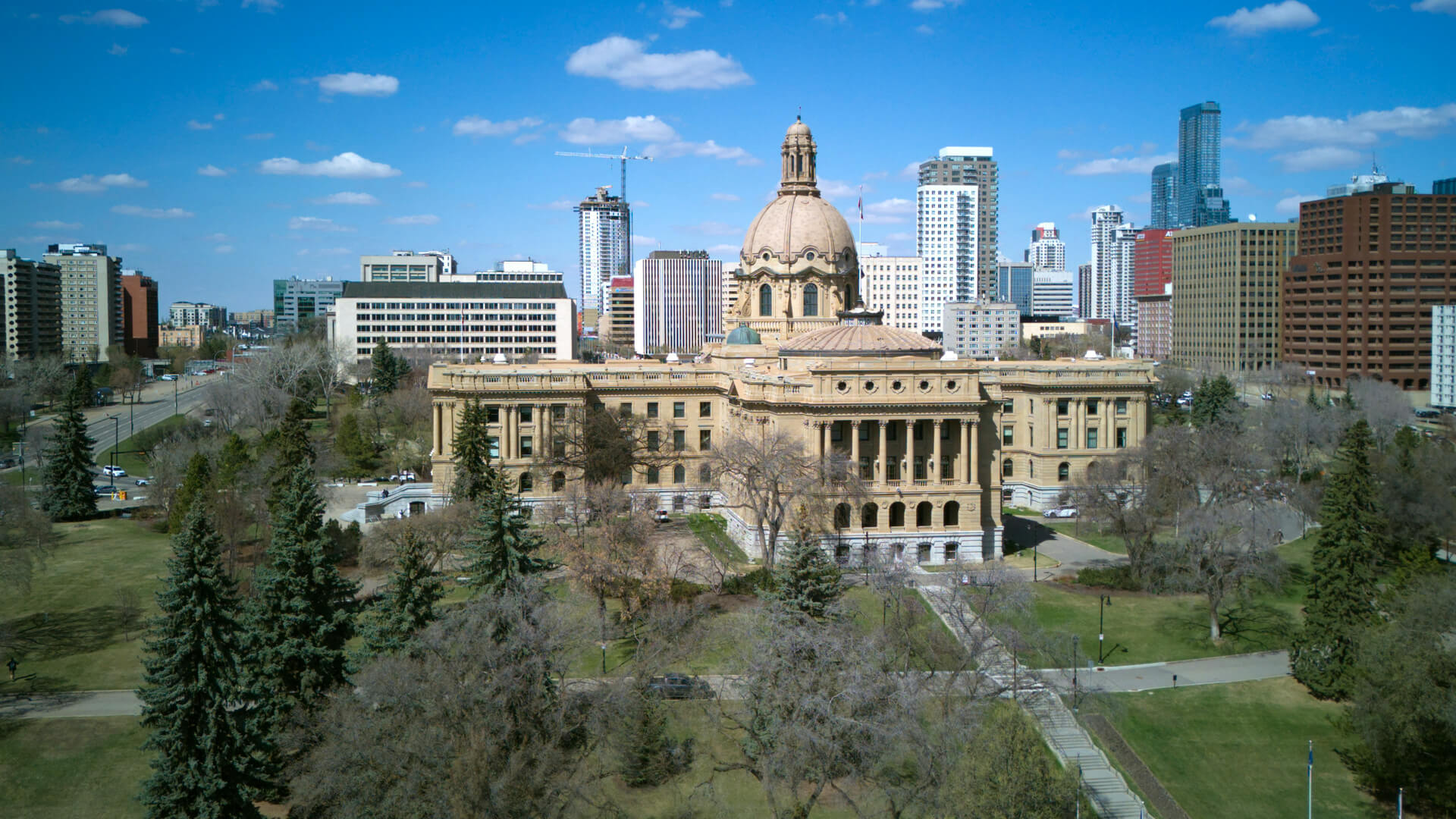
Soft Oil Prices Take a Toll on the Books: Our Analysis of the Alberta Budget 2026
The province is forecasting a deficit of $9.4 billion for fiscal year 2026–27, with expected shortfalls of $7.6 billion in 2027–28 and $6.9 billion in 2028–29. These figures are significantly worse than last year’s budget, which projected deficits in the $2-billion range for the two upcoming fiscal years.
- Weak oil prices are the main reason for the province’s persistent deficits. Higher than previously planned spending on healthcare is also playing a role.
- The provincial government expects taxpayer-supported debt to rise from $92.1 billion in 2025–26 to $137.5 billion by 2028–29. This will push its net debt-to-GDP ratio to 12.9 per cent by the end of the three-year forecast horizon.
- Total revenues are expected to fall by 1.0 per cent in fiscal year 2026–27 before posting stronger gains of 5.9 per cent and 3.3 per cent in the following two years, respectively.
- The improvement in revenue growth over the budget horizon is predicated on a recovery in oil prices and reflects a more optimistic oil price outlook than our own. While weaker oil prices would likely result in larger deficits in the years ahead, the province’s assumption of a wider light-heavy differential than us helps cushion some of that downside risk. Beyond that, a $2 billion dollar contingency in each of the next three years provides some buffer for risk.
- Expenses are forecast to rise by 5.7 per cent in fiscal year 2026–27, 3.1 per cent in 2027–28, and by 2.3 per cent in 2028–29. The increase will be largely driven by healthcare spending, reflecting higher spending for physicians in addition to investments to expand healthcare.
- The province’s baseline scenario assumes that tariffs in place as of January 14, 2026, remain unchanged over the forecast horizon, resulting in expected real GDP growth of 1.8 per cent in 2026, 2.3 per cent in 2027, and 2.2 per cent in 2028. These GDP estimates are more conservative than our own as they do not assume tariffs will be lifted by the end of this year.
- It was acknowledged that Canada–U.S. trade policy continues to be a significant risk to Alberta’s outlook, particularly with the mandatory review of CUSMA still to come this year. The government also suggests that its strong position in U.S. Midwest and Rocky Mountain regions will help mitigate competitive pressures from increased heavy crude supply from Venezuela, although some widening of the light-heavy differential is still expected.
- Alberta is only permitted to run fiscal deficits for three consecutive years under its Sustainable Fiscal Planning and Reporting Act, though the government is reviewing this framework in light of its projected path of deficits that would make the framework difficult to plan within.
- The latest budget introduces two new tax policy measures. One of which is a 6.0 per cent tax on rental vehicles, creating a new revenue source from visitors and tourists beginning in 2027. The other is a new levy on large-scale data centres, with rates up to 2.0 per cent that are calculated based on the value of their computing equipment, taking effect in fiscal year 2028–29.
- As of April 1, 2026, Alberta’s tourism levy on hotels, motels, and inns will increase from 4.0 to 6.0 per cent. This is projected to generate $200 million or more in tax revenue in each of the next three fiscal years.
- Following an above-average wildfire season in 2025, the province is taking a more proactive approach ahead of future seasons, committing $38 million over the next three fiscal years toward wildfire management initiatives. Future capital plans will also outline the financing framework for five waterbombers, with deliveries to begin in 2031. Wildfires and natural disasters more broadly continue to be a downside risk to fiscal planning across the country.
- Alberta has reaffirmed its intention to boost the Heritage Fund to $250 billion by 2050, but the next few years will see limited growth, as contributions will be held down by projected deficits.
Custom Economic Research
Want to know how the latest budget impacts your business? Our custom solutions provide tailored insights and strategic guidance.
Key insights
To rise and fall with the price of a barrel. Alberta’s fiscal stance remains closely linked to oil markets despite ongoing efforts to diversify the economy. Non-renewable resource revenues—particularly in the form of bitumen royalties—continue to have an outsized influence on government finances, leaving the budget highly sensitive to fluctuations in global crude prices. Periods of weak prices have historically led to fiscal strain, as seen in the string of deficits that followed the 2014 oil price collapse. While geopolitical tensions can trigger price spikes, underlying fundamentals currently point to softer conditions. For Alberta, this environment portrays another difficult fiscal year ahead, with bitumen royalties estimated to be nearly $3 lower than last fiscal year and a lack of appetite for tax increases leading to a sizeable deficit.
Tax hikes were largely restrained. Budget 2026 held firm on last year’s personal income tax cut, choosing to raise revenues through a series of smaller measures. These include the new rental vehicle and data centre tax policies, an increase to the province’s tourism levies, and an increase to education property tax rates. Each measure was designed to increase revenues while maintaining the province’s commitment to have one of the most favourable tax environments in Canada. This constrained approach to taxation, combined with rising expenditures and a weaker oil price environment, has left Alberta in a more difficult fiscal situation compared to just a year ago.
Overall, the province’s fiscal health remains relatively strong, but pressure points persist. The province still boasts the lowest provincial net-debt-to-GDP ratio in the country, projected at 10.5 per cent for fiscal year 2026–27, giving it some room to handle its deficits. Further, the economic outlook for the province remains bright. In recent years, Alberta has led the country in population growth, and many recent arrivals are still entering the workforce. As newcomers are generally of working age, the province’s young demographic will continue to support growth in income tax revenues and help to ease pressures from an aging population. That said, the province must tread carefully given the inherent volatility in its revenue streams, and the need for higher oil prices to balance its books.

The Provincial Fiscal Outlook provides an independent five‑year forecast of each province’s finances, offering an objective evaluation of government budget projections and the economic trends and risk factors that could challenge them.
2026 Budget Analyses

Federal Spring Economic Update 2026: Sticking to the Plan
Français The spring economic update showed that the federal government is doubling down on its plan to build the nation, with most policy measures focused on boosting private investment. A…
Ontario Budget 2026: Another Province with Bigger-than-expected Deficits
Persistent trade tensions with the United States and global economic uncertainty have once again disrupted Ontario’s fiscal outlook, leading to an expected deficit of $13.8 billion for fiscal year 2026–27,…

Quebec’s Prudent Path to Balance Narrows: Our Analysis of the Quebec Budget 2026
Français The province’s deficit for fiscal year (FY) 2026-27 is projected to be $6.3 billion, down from $7.1 billion from the autumn fiscal update. The deficit is forecast to gradually…
Soft Oil Prices Take a Toll on the Books: Our Analysis of the Alberta Budget 2026
The province is forecasting a deficit of $9.4 billion for fiscal year 2026–27, with expected shortfalls of $7.6 billion in 2027–28 and $6.9 billion in 2028–29. These figures are significantly…
Debt to Balloon as Province Attempts to Maintain Core Services: Our Analysis of the British Columbia Budget 2026
British Columbia is anticipating a deficit of $9.6 billion in fiscal year 2025-26. Despite being lower than government projections of $11.2 billion issued in the fall of last year, it…
Related Insights
-
Mise à jour économique du printemps 2026 – Le gouvernement s’en tient au plan
English La mise à jour économique du printemps montre que le gouvernement fédéral redouble d’efforts pour concrétiser son plan de…
-
Ontario Budget 2026: Another Province with Bigger-than-expected Deficits
Persistent trade tensions with the United States and global economic uncertainty have once again disrupted Ontario’s fiscal outlook, leading to…
-
Le chemin prudent du Québec vers l’équilibre se rétrécit : notre analyse du Budget du Québec 2026
English Le déficit de la province pour l’exercice 2026‑2027 devrait s’établir à $6,3 milliards, en baisse par rapport aux $7,1 milliards prévus…