

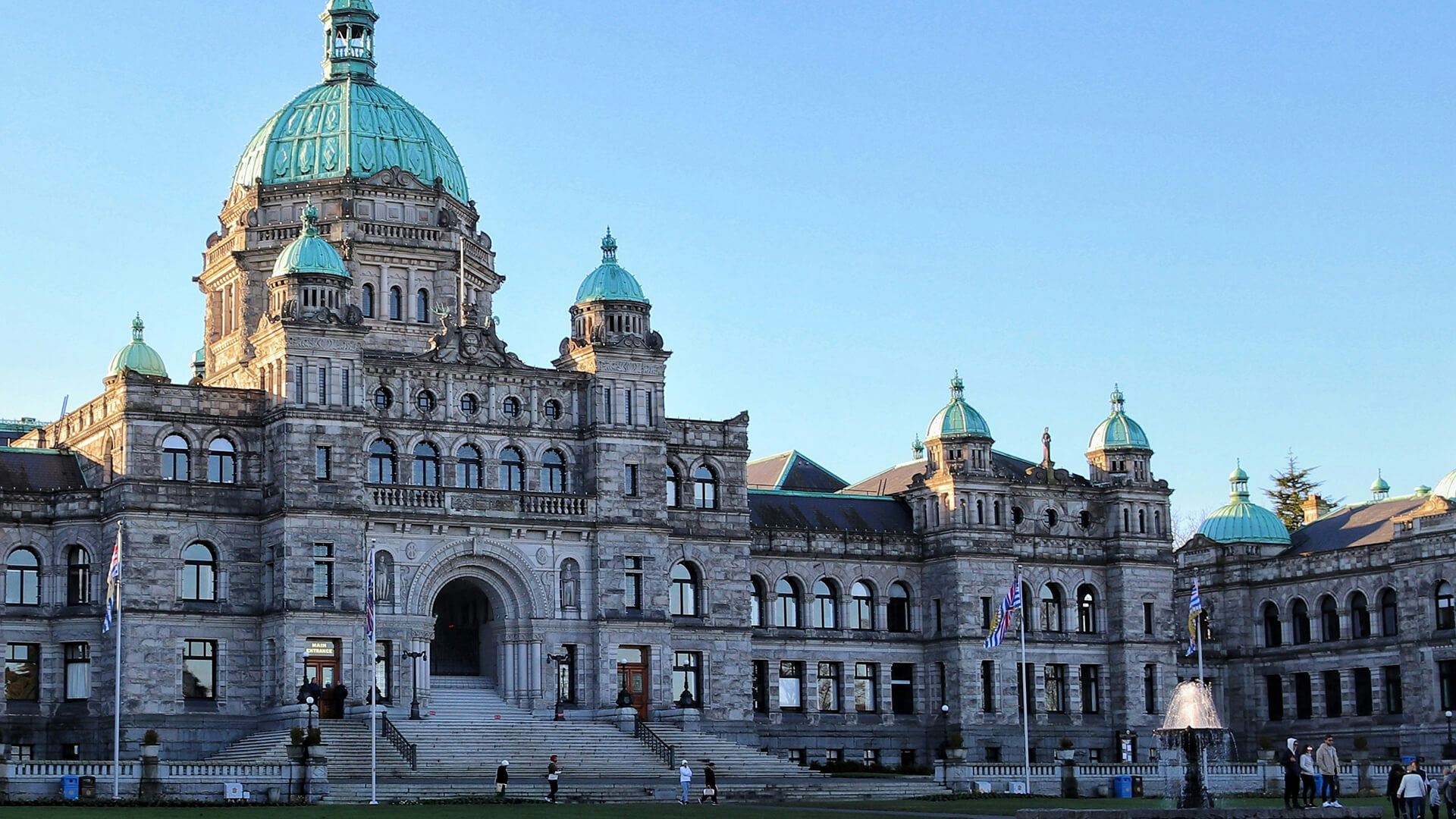
Debt to Balloon as Province Attempts to Maintain Core Services: Our Analysis of the British Columbia Budget 2026
British Columbia is anticipating a deficit of $9.6 billion in fiscal year 2025-26. Despite being lower than government projections of $11.2 billion issued in the fall of last year, it is the largest deficit in B.C.’s history.
- For the 2026-27 fiscal year, the government expects to post a record deficit of $13.3 billion. That figure will narrow to $11.4 billion in 2028-29, still higher than historic levels.
- Though deficits are projected to decrease, the government expects that provincial taxpayer-supported debt will increase to $189 billion by the end of the 2028-29 fiscal year. This will bring the taxpayer-supported debt-to-GDP ratio to 37.4 per cent in 2028-29 from 26.1 per cent in the current fiscal year.
- The interest paid per dollar of revenue will rise to 8.2 cents in 2028-29 from 4.9 in the current fiscal year.
- Major new spending is focused on core services, with $3.9 billion directed to health care, education, and social services over the next three years. Most of this—$2.8 billion—is for health care alone, making it the single largest area of increased funding. At the same time, per capita spending on these services will grow at a much slower pace than in recent years.
- Beyond core services, spending was kept to a minimum in Budget 2026 as the government focuses on reigning in costs. Some of these savings will be found through delaying capital projects, such as the Burnaby Hospital redevelopment and several long-term care centres.
- The government is trying to control spending through its expenditure management and efficiency review launched last year. As part of this, it plans to reduce the public sector workforce by 15,000 positions over the next three years, which is expected to save $2.85 billion over that period.
- When these workforce reductions are combined with other expenditure management measures, the province expects to save $1.1 billion in 2026–27 and a cumulative $6.4 billion by 2028–29.
- In addition to lowering costs, finding new sources of tax revenue is part of the province’s fiscal strategy. Measures include an increase on the first income tax bracket, expanding the provincial sales tax to include some professional services and an increase to the Speculation and Vacancy Tax for foreign property owners.
- The budget acknowledges the fiscal impact of the repeal of the consumer carbon tax, noting that carbon tax revenues were previously used to pay for tax cuts in other areas (including personal income tax and small business corporate tax).
- Other new measures aim to stimulate investment, including a temporary 15 per cent tax credit for businesses investing in buildings and machinery and equipment used in manufacturing and processing. A new $400 million Strategic Investments Special Account to leverage federal partnerships was also announced.
- The deficit includes $5 billion in contingencies funding for each of the next three fiscal years. This figure has been raised from $4 billion in the current fiscal year. Some of these funds will likely be used to help absorb other pressures on the balance like higher wages for yet-to-be-negotiated public sector collective agreements and the potential for a weaker economic performance.
- The government’s baseline forecast of economic growth is more conservative than our own analysis. In 2026, the province expects real GDP to increase by 1.3 per cent, while we anticipate growth of 1.7 per cent. Our growth expectations are also stronger for 2027-28, contingent on a renegotiation of the Canada-United States-Mexico Agreement, and eased tariffs and trade tensions between the U.S. and Canada.
Custom Economic Research
Want to know how the latest budget impacts your business? Our custom solutions provide tailored insights and strategic guidance.
Key Insights
Budget 2026 was delivered with a sobering tone. The province anticipates a record deficit in 2026-27 and only a gradual improvement over the next few years thanks to modest economic growth and pressures to core services. The government’s primary way to narrow the deficit is through reducing administrative costs, though tax increases were also part of the package.
In a tough situation. The government tabled Budget 2026 in a difficult fiscal situation. Despite modest increases in program spending, the province will continue to see record deficits over the next three years with no clear plan to balance its budget. In our view, the best way forward is to focus on measures to stimulate investment and boost productivity in the province to strengthen the economy longer term. This is where the government should have went a step further. New measures were mostly modest in nature, including the hallmark Special Account Funding which had a greater focus on partnering with federal initiatives rather than directly boosting private investment. Tax credits for businesses were welcome but are temporary and unlikely to move the needle much on private sector investment. We also think policies aimed at diversifying trade and building resilience for the economy longer term should have had a greater focus in Budget 2026.
Public cuts will affect regions differently. While we understand the public service is the most obvious target to reduce spending, we’re worried that the size of the planned job cuts will have a significant impact on Vancouver Island’s economy, where many of these jobs are located. In Victoria, public administration accounted for 13 per cent of jobs in 2025, and many of these are provincial employees whose jobs will be at risk. Large layoffs in the region would have a widespread impact for its economy, with consumer-facing sectors like retail, hospitality, and finance likely to be especially hard hit.
B.C.’s persistent deficit spending could leave the province increasingly vulnerable to economic shocks. Fiscal stabilization appears to be deferred beyond the current budget timeline. Following a record-breaking deficit, another three anticipated years (at least) of high deficits will worsen the province’s financial position and its ability to respond to the next emergency (e.g., wildfires, tariffs, pandemics, etc.). Revenue growth could face more downward pressure over the next several years as weaker population growth continues to cool the economy. The province does have enviable prospects in industries like mining and energy, and B.C. currently maintains one of the lowest debt-to-GDP ratios among the provinces. However, if unaddressed, these persistent deficits will chip away at this fiscal advantage and crowd out spending on future priorities.

The Provincial Fiscal Outlook provides an independent five‑year forecast of each province’s finances, offering an objective evaluation of government budget projections and the economic trends and risk factors that could challenge them.
2026 Budget Analyses

Federal Spring Economic Update 2026: Sticking to the Plan
Français The spring economic update showed that the federal government is doubling down on its plan to build the nation, with most policy measures focused on boosting private investment. A…
Ontario Budget 2026: Another Province with Bigger-than-expected Deficits
Persistent trade tensions with the United States and global economic uncertainty have once again disrupted Ontario’s fiscal outlook, leading to an expected deficit of $13.8 billion for fiscal year 2026–27,…

Quebec’s Prudent Path to Balance Narrows: Our Analysis of the Quebec Budget 2026
Français The province’s deficit for fiscal year (FY) 2026-27 is projected to be $6.3 billion, down from $7.1 billion from the autumn fiscal update. The deficit is forecast to gradually…

Soft Oil Prices Take a Toll on the Books: Our Analysis of the Alberta Budget 2026
The province is forecasting a deficit of $9.4 billion for fiscal year 2026–27, with expected shortfalls of $7.6 billion in 2027–28 and $6.9 billion in 2028–29. These figures are significantly…
Debt to Balloon as Province Attempts to Maintain Core Services: Our Analysis of the British Columbia Budget 2026
British Columbia is anticipating a deficit of $9.6 billion in fiscal year 2025-26. Despite being lower than government projections of $11.2 billion issued in the fall of last year, it…
Related Insights
-
Mise à jour économique du printemps 2026 – Le gouvernement s’en tient au plan
English La mise à jour économique du printemps montre que le gouvernement fédéral redouble d’efforts pour concrétiser son plan de…
-
Ontario Budget 2026: Another Province with Bigger-than-expected Deficits
Persistent trade tensions with the United States and global economic uncertainty have once again disrupted Ontario’s fiscal outlook, leading to…
-
Le chemin prudent du Québec vers l’équilibre se rétrécit : notre analyse du Budget du Québec 2026
English Le déficit de la province pour l’exercice 2026‑2027 devrait s’établir à $6,3 milliards, en baisse par rapport aux $7,1 milliards prévus…